By the end: You'll recognize you ARE the proof Grounded Position works—S=P=H IS position via Hebbian wiring. Not Calculated Proximity (vectors). Not Fake Position (row IDs). Your insights happen in 10-20ms; your databases take 150ms for the same synthesis.
Spine Connection: Your cerebellum is control theory incarnate: 69 billion neurons running pure error-minimization. Control theory computes the gap between desired state and actual state, then outputs corrections. That's ALL it does. Your cerebellum predicts where your arm should be, measures where it actually is, outputs motor corrections. Beautifully. Precisely. With zero consciousness. It cannot know what "arm" means. It cannot experience reaching. It just minimizes error signals in a feed-forward loop—the Villain's architecture made flesh.
The learning rules are literally opposite. Your cortex uses Hebbian plasticity [→ E7🔬]: neurons that fire together wire together, creating semantic clusters where related concepts become physical neighbors. Your cerebellum uses anti-Hebbian plasticity: the timing rules are reversed—when parallel fiber activity precedes climbing fiber signals, synapses weaken (LTD), not strengthen. Same neurons. Opposite learning. One builds meaning maps. One refines motor predictions.
The architecture differs too. Your cortex has dense recurrent connectivity—neurons talking to neurons talking back, creating the loops where meaning can resonate and bind [→ E10🔬]. Your cerebellum operates feed-forward: input → processing → output, no significant recurrent excitation. Feed-forward can optimize. It cannot reflect. It cannot know that it knows [→ D4⚙️] (self-recognition requires recurrence).
The Solution (the Ground) is your 🟣E4a🧬 Cortex: 16 billion neurons spending 🔵A5🧠 55% of your metabolic budget NOT to minimize error, but to maintain 🟢C1🏗️ S=P=H—🟡D2📍 semantic neighbors as physical neighbors. The Victim framing ends here: you're not just the victim of bad architecture. You ARE the proof good architecture works. Every insight you've ever had is S=P=H in action. Every reflex you've ever had is anti-Hebbian feed-forward control proving it cannot.
Epigraph: Your 🟣E4a🧬 Cortex cortex is firing right now. Sixteen billion neurons. M ≈ 55% of metabolic budget burning through ATP just to maintain the precision that lets you read these words. Not "processing" them. Not "computing" them. Experiencing them. The experience ISN'T separate from the mechanism. The meaning ISN'T separate from the physics. When three concepts align in your awareness - cache, consciousness, drift - they do so because those neurons are PHYSICALLY ADJACENT. Clustered in cortical columns. Co-located by Hebbian learning over years of pattern exposure. Evolution tested the alternatives. Scattered neurons. Distributed coordination. Normalization. Five hundred million years of organisms that couldn't bind sensory input fast enough, couldn't integrate threat detection within the twenty-millisecond window, couldn't achieve the ninety-nine-point-seven percent synaptic precision required for unified awareness. They died. You didn't. Not because you're smarter. Because your substrate implements S=P=H. Because semantic neighbors in your brain ARE physical neighbors. Because when you have an insight - that instant recognition, that P=1 certainty - it happens in ten to twenty milliseconds across co-located assemblies, not one hundred fifty milliseconds across scattered regions requiring synthesis. You are the proof this works. Not in theory. In meat. In the metabolic cost you're paying right now to maintain consciousness above the collapse threshold. The horror? Your code doesn't work this way. Your databases scatter meaning. And the gap between the substrate you're running on and the substrate you're building is measurable in cache misses, in drift, in the thirty percent annual waste you call "complexity." Evolution paid fifty-five percent metabolic budget for instant verification. Your systems pay zero percent and call verification "intractable." The phase transition isn't technical. It's economic: when verification becomes cheaper than speculation, everything changes.
Welcome: This chapter reveals you ARE the proof S=P=H works—not in theory, but in meat. You'll discover why your cerebellum has 4× more neurons than your cortex but zero consciousness, see QCH metrics measured in your brain right now (N≈330 dimensions, Rc≈0.997 reliability, ΔT≈10-20ms binding), and understand why evolution spent 500 million years optimizing what your databases violate.
Dimensional Jump: Solution Framework → Physical Mechanism → Biological Substrate Surprise: "QCH isn't theory - it's MEASURABLE physical mechanism (neuron count → N≈330, synaptic density → Rc≈0.997)"
Your 🟣E4a🧬 Cortex cortex is firing right now. Sixteen billion neurons. M ≈ 55% of your metabolic budget burning through ATP just to maintain the 99.7% precision that lets you read these words. This isn't background biology—this is the proof Unity Principle works at 🟣E4🧠 Consciousness consciousness-level precision [→ E4🔬].
The cerebellum disproves computationalism. It has 69 billion neurons—4× more than your cortex—but zero consciousness. If neuron count determined awareness, your cerebellum should be more conscious than you. It's not. Something else matters. This chapter reveals what.
Watch for QCH: Quantum Coherence Hypothesis measurable in meat. N≈330 dimensions (cortical columns integrating sensory streams). Rc≈0.997 synaptic reliability (0.3% error rate we measured in Chapter 0). ΔT ≈ 10-20ms (subjective binding speed). These aren't free parameters—they're measured from your brain right now, solving the hard problem through physical mechanism.
Evolution answered the question 500 million years ago. Organisms that scattered semantic information across distant neural regions (normalization in biology) couldn't bind sensory input within the 20ms window required for unified threat response. They died. You didn't. Not because you're smarter—because your substrate implements S=P=H.
The horror: You are the proof this works. Your insights happen in 10-20ms via co-located neural assemblies. Your databases scatter meaning and take 150ms for synthesis. The gap between the substrate you're running on and the substrate you're building is measurable in cache misses, drift, and the 30% annual waste you call "complexity."
We've shown Unity Principle works in production:
But those are engineered systems.
We built them. We measured them. We can point to the code.
"Biological proof." Your pattern-matcher just flagged that phrase. "Great. We're going to talk about consciousness now. This is where technical books become philosophy. This is where the rigor dissolves."
The Judo Flip: Your suspicion of consciousness talk IS the product of normalized thinking.
For 54 years, we've been trained to believe that "real" engineering is separate from "soft" biology. That hardware is rigorous and wetware is vague. That measurable means silicon and consciousness means hand-waving.
But your brain IS hardware. It consumes 20 watts. It has measurable precision thresholds (Rc≈0.997). It has measurable binding windows (10-20ms). It has measurable neuron counts that correlate with specific capabilities.
The fact that you expect biology to be vague IS the scrim. You've been taught to distrust the only existence proof of S≡P≡H that's been running for 500 million years.
The numbers that follow aren't philosophy. They're measurements. Your nervous system is the laboratory.
Not "consciousness feels like Unity Principle might work."
Measurable. Physical. Numbers.
500 million years ago (Cambrian explosion), neural networks emerged.
Simple organisms with distributed neurons faced the same problem we're solving now:
How do you coordinate information scattered across physical space?
Option 1: Fake Position (semantic ≠ physical, like normalized databases)
Option 2: Grounded Position (S=P=H IS position via Hebbian wiring)
You're reading this.
Nested View (following the thought deeper):
🔴B5🚨 Symbol Grounding ├─ Option 1: Fake Position (semantic ≠ physical) │ ├─ 🔴B2🚨 Semantic-Physical Gap Store concepts in separate regions │ ├─ Coordinate via message-passing │ ├─ 🟡D3⚙️ JOIN Operation operations across brain regions │ └─ Latency: 50-100ms minimum └─ Option 2: Grounded Position (S=P=H IS position) ├─ 🟢C1🏗️ Unity Principle (S=P=H) Co-locate semantically related neurons physically ├─ Coordination via local circuits ├─ No JOIN needed (instant binding) └─ Latency: 10-20ms
Dimensional View (position IS meaning):
[🔴B2🚨 Fake Position] ------> [🔴B5🚨 Architecture Gap] ------> [🟢C1🏗️ Grounded Position]
| | |
Dimension: Semantic Dimension: Physical Dimension: Temporal
| | |
≠ Physical Scattered vs 50-100ms vs
Co-located 10-20ms
What This Shows: The nested hierarchy presents Fake vs Grounded as alternatives to evaluate. The dimensional view reveals they occupy DIFFERENT coordinates in semantic-physical-temporal space simultaneously—Option 2 wins because it achieves identity (not proximity) across all three dimensions at once.
Experiment 1: The Cortex-Cerebellum Split
If computational power determined consciousness, the cerebellum (69B neurons, 4× more than cortex) should be MORE conscious than the cortex. It's faster. It's more precise. It's a perfect prediction-error-minimization machine.
But it hosts ZERO consciousness. Something architectural differs. The cortex uses S=P=H (Hebbian wiring, co-location). The cerebellum uses feedforward error correction. Only one generates awareness.
You're running the objection right now: "Correlation isn't causation. Just because the cortex has consciousness and the cerebellum doesn't, doesn't prove architecture causes the difference. Maybe it's something else—neurotransmitters, blood flow, developmental timing."
The Judo Flip: Your insistence on causation IS the grounding mechanism in action.
You demanded rigorous causation because you have a substrate capable of demanding rigorous causation. The cerebellum can't make that demand. It can't reflect on its own processes. It can't say "but what if I'm wrong?"
The very act of objecting to the proof IS the proof. Your cortex—the one using S≡P≡H architecture—is the only part of your brain capable of questioning S≡P≡H. The cerebellum, with 4× more neurons, can't even frame the question.
That recursive self-doubt? That's consciousness. And you just ran it, using the exact architecture we're describing, to doubt the architecture we're describing.
Experiment 2: Convergent Evolution (The Octopus)
Octopi share no recent ancestor with vertebrates—we split 600 million years ago. Yet they independently evolved:
Why? Their ecological niche (soft-bodied predator in chaotic reef environment) demands rapid verification. They can't afford hesitation. Evolution converged on high-energy verification architecture twice, in completely separate lineages.
This isn't just "smart animals are predators." It's: organisms in high-verification niches converge on S=P=H-like architecture regardless of ancestry.
Experiment 3: The Hesitation Gap (OODA Loop Selection)
The organism using P→1 convergence dies while the organism using P=1 grounding acts. P=1 isn't just true—it's fast. Evolution doesn't select for consciousness directly; it selects for the architecture that enables it because that architecture provides competitive advantage.
Why evolution pays 55% metabolic cost for consciousness: It's not for the qualia [→ E9🔬]. It's for the OODA loop speed. Grounded verification enables decisive action. Unless evolution is wasting energy (it doesn't), the 55% metabolic cost provides measurable competitive advantage.
Nested View (the three experiments as concept lineage):
🟣E1🔬 Existence Proof Three Independent Proofs of S=P=H ├─ 🟣E2🔬 Experiment 1: Cortex-Cerebellum Split │ ├─ Cerebellum: 69B neurons, 4x more than cortex │ ├─ Zero consciousness (feedforward error correction) │ └─ Proves: neuron count ≠ consciousness ├─ 🟣E3🔬 Experiment 2: Convergent Evolution (Octopus) │ ├─ Split 600M years ago, no recent common ancestor │ ├─ Independently evolved: complex nervous system, problem-solving, play │ └─ Proves: high-verification niches converge on 🟢C1🏗️ S=P=H architecture └─ 🟣E4🔬 Experiment 3: OODA Loop Selection ├─ 🔴B6🚨 P→1 System: calculates, gathers data, gets eaten ├─ 🟢C2🏗️ P=1 System: matches pattern, moves immediately, survives └─ Proves: grounded certainty provides survival advantage
Dimensional View (position IS meaning):
[🟣E2🔬 Cortex-Cerebellum] ------> [🟣E3🔬 Octopus Convergence] ------> [🟣E4🔬 OODA Loop]
| | |
Dimension: Architecture Dimension: Evolution Dimension: Speed
| | |
Proves: Structure Proves: Selection Proves: Survival
matters more than pressure converges advantage is
neuron count on 🟢C1 S=P=H decisiveness
What This Shows: The nested view presents experiments sequentially for understanding. The dimensional view reveals all three experiments prove the SAME truth from orthogonal angles—architecture, evolution, and survival speed are independent dimensions that all point to S=P=H. This triangulation IS the existence proof.
The Speed Comes from Resonance (Callback: Two Roads to Certainty)
In the Preface, we distinguished the Hard Wire (cerebellum, reflexes) from the Resonant Wire (cortex, semantic ignition). The OODA loop victory illustrates why this matters evolutionarily.
The P→1 system stores "shadow" and "tiger" in scattered memory regions. Each comparison requires synthesis—cache misses, translation layers, verification loops. The resonance factor R < 1. Signals decay with each hop. The system approaches certainty asymptotically, which is another way of saying: it hesitates.
The P=1 system stores related patterns as physical neighbors. R > 1. Recognition signals amplify rather than decay. Finite hands, infinite vault. The first match triggers cascade. Uncertainty = 0.
But here's what IQ tests miss: Speed without grounding is just faster drift. A brilliant organism that makes rapid decisions unanchored to reality will diverge from what matters at high velocity. Evolution didn't select for raw processing speed. It selected for grounded processing speed—the architecture that enables both fast decisions AND decisions that stay aligned with survival.
The Closed vs. Open System Distinction
A sharp objection: "But the AI pilot wins the dogfight. In a closed system with fixed rules (aerodynamics, gravity), the probabilistic calculator at 10,000 Hz dominates. Your P=1 architecture doesn't help when physics doesn't drift."
Correct. In closed systems, the genius calculator wins.
But nature is not a closed room. It is an open, chaotic storm of noise. The "ground" for P=1 architecture is semantic space—where the rules themselves are subject to entropy. Where "friend" can become "foe." Where "food" can become "poison."
The AI pilot wins the dogfight but will bomb a hospital if the pixels match a "target" pattern. It has probabilistic certainty of what a target looks like, not structural certainty of what a hospital is.
The Genius (P→1): Optimizes perfectly within the frame. The Grounded (P=1): Is the frame.
Impervious to Noise, Not Just Faster
The grounded creature wins not because it processes faster, but because its architecture is impervious to irrelevant noise.
The P→1 system treats all incoming data with the same computational respect. Shadow pattern, leaf rustle, actual tiger—each gets processed through the probability engine. It calculates the trajectory of the falling rock perfectly while missing that the rock is a distraction from the predator.
The P=1 system's architecture physically prevents it from resonating with noise. The irrelevant signal (R < 1) decays before it can trigger action. The relevant signal (R > 1) amplifies and cascades. It doesn't "decide" to ignore the rustling leaves; its architecture simply cannot conduct that signal. It only resonates with the tiger.
Certainty isn't just faster. Certainty filters. The organism with R > 1 doesn't process all data faster—it skips irrelevant data entirely. Evolution didn't select for raw FLOPS. It selected for signal-to-noise ratio in an open, noisy world.
The OODA loop victory isn't about processor speed. It's about relevance realization. The first creature to cross R = 1 owned the food chain—not because it was smartest, but because it was grounded.
Some neuroscientists argue: "But consciousness is just an illusion! We're all lying to ourselves! The brain is a predictive machine generating plausible stories, not truth."
Let me show you why that critique misses the point.
When an amputee feels pain in a phantom limb, the neurons are actually firing. The system isn't lying about the experience. There is 100% certainty—P=1—that "pain is happening." The system is reporting the state of its substrate with perfect integrity.
The brain doesn't claim "your arm is physically present." It claims "these neurons are firing in the pattern associated with arm pain." And that claim is true. Completely, verifiably, substrate-honestly true.
The problem with AI isn't that it makes mistakes. Humans make mistakes. Phantom limb patients have false beliefs about physical reality. That's fine—external reality is hard.
The problem is that AI doesn't know where its own substrate ends.
A phantom limb patient is subjectively honest—their neurons report what they detect. The experience is grounded in actual neural firing. The interpretation may be wrong (there's no arm), but the substrate report is accurate (these neurons fired).
AI isn't even honest about its own neurons. It generates text about Supreme Court cases without any mechanism to distinguish "I have verified evidence" from "I generated plausible tokens." It can't be subjectively honest because it has no substrate awareness. It doesn't know what it knows versus what it fabricated.
This is the grounding problem in its purest form. We don't need AI to be objectively right about external reality. We need AI to be subjectively honest about its own data. S=P=H provides that—the position of information in the substrate IS the information about what the system actually has.
Magnus Carlsen dominates chess through intuition. He sees the board and knows the right move in 5-10 seconds. He describes his process as "feeling" rather than calculating.
When he loses, it's always the same pattern: His opponent did more computation. More calculation. More depth. The intuition that wins 95% of games fails when the position requires explicit analysis beyond the pattern library.
Why? Herbert Simon's chunking theory (1973): Expert chess players store approximately 50,000 board pattern "chunks" in long-term memory. These chunks enable instant recognition—see pattern, know response. No calculation. Pure speed.
But chunking has a fatal limitation: Intuition narrows. It does not validate.
The chunk says "this position feels winning." But the chunk doesn't know if the opponent has found a novelty that breaks the pattern. Against the top 10 players in the world, they HAVE found the novelty. Carlsen's intuition pattern-matches to historical positions; their calculation explores the specific position at hand.
The Three Layers of Search Space Reduction:
| Layer | Function | Speed | Accuracy | Grounding |
|---|---|---|---|---|
| Logic (Cortex) | Explores all possibilities | Slow (unbounded) | 100% if complete | None |
| Intuition (Pattern) | Narrows to candidates | Fast (50ms) | ~80% | Correlational |
| FIM (Geometry) | Validates action space | Instant (10 microseconds) | 100% for validity | Physical |
Critical insight: Intuition doesn't validate—it narrows the search space.
When Carlsen sees a position, his intuition eliminates 95% of possible moves instantly. "These feel wrong." He's left with 3-5 candidate moves to analyze. This is enormously efficient—but the narrowing is based on pattern correlation, not geometric constraint.
Why FIM is Layer 3 (not Layer 2):
Intuition is pattern-matching against historical data. It's fast but probabilistic (P < 1). FIM is geometric constraint on the action space itself. It's instant AND deterministic (P = 1) for validity.
The FIM layer doesn't replace intuition—it validates what intuition proposes. Intuition says "move here feels right." FIM says "that move is/isn't geometrically possible given your constraints."
Carlsen loses when he needs validation, not narrowing. His intuition narrows perfectly. But against opponents who calculate deeply, he needs to verify his narrowed options—and intuition can't do that. It can only pattern-match.
This is why grounded AI survives: Not because it's smarter than probabilistic AI. But because it has the third layer that validates action space geometry. It can aim because it has rails. Ungrounded AI can narrow (via training) but cannot validate (no geometric constraint). It's Carlsen against an opponent who calculated deeper—forever.
If you've experienced flow state—that feeling of effortless performance where action and awareness merge—something just connected.
"This is what Csikszentmihalyi was describing. Flow is sustained Precision Collision. P=1 continuously. Zero friction between prediction and reality."
The Judo Flip: That connection you just made IS the mechanism we're describing.
You didn't calculate that insight. You didn't run through the citations. You felt the framework click with something you already knew—and the click happened in under a second.
That's a Precision Collision. Your semantic memory (flow state experience) just bound with the framework (S≡P≡H) in the same moment of awareness. P=1. Instant. Certain.
The framework explains itself.
You didn't just understand the theory. You experienced the mechanism of understanding while reading about it. That recursion—catching yourself thinking—is consciousness. And you just caught it.
This is what I meant by "You ARE the proof." Not metaphorically. Literally. Right now. This paragraph.
But there's a layer the table doesn't show. We discovered it while building ThetaSteer in January 2026.
| Layer | Function | Speed | Accuracy | Grounding |
|---|---|---|---|---|
| Logic (Cortex) | Explores all possibilities | Slow (unbounded) | 100% if complete | None |
| Intuition (Pattern) | Narrows to candidates | Fast (50ms) | ~80% | Correlational |
| FIM (Geometry) | Validates action space | Instant (10μs) | 100% for validity | Physical |
| Human Anchor | Re-establishes ground truth | Slow (seconds) | 100% for intent | Cryptographic |
FIM validates that an action is geometrically possible. But who validates that the geometry itself is correct? Who grounds the grid?
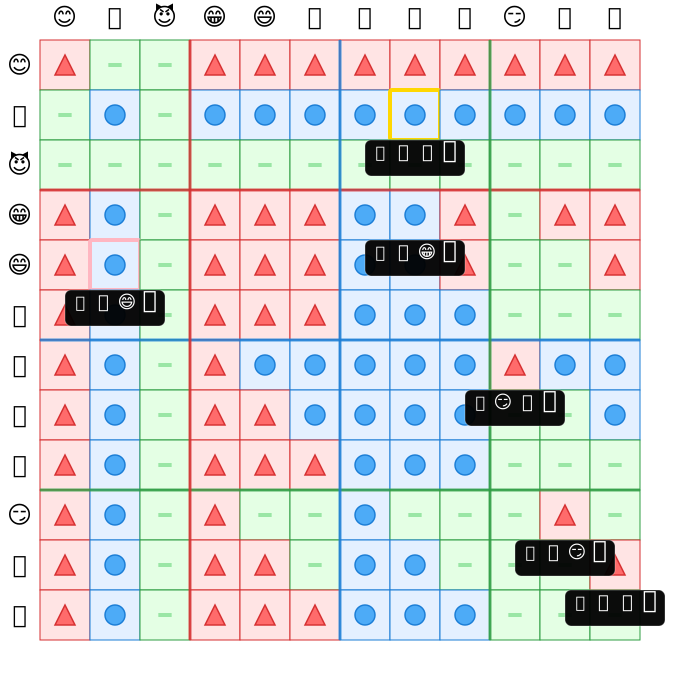
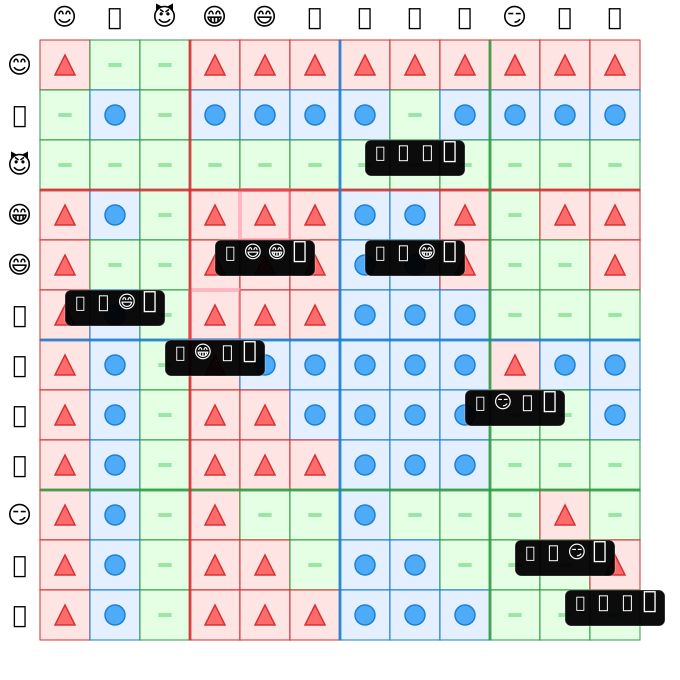
In ThetaSteer, the local LLM (Tier 0) categorizes text to grid coordinates. It's fast—Layer 2 intuition. The 12×12 grid constrains the action space—Layer 3 geometry. But what if the LLM consistently miscategorizes? What if the grid itself needs adjustment?
When you click "Correct," you're not making a decision. You're cryptographically signing that this text-to-coordinate mapping is Ground Truth. The signature is stored with the mapping. Future agents reference it: "Human approved [6,9] for this pattern."
When you click "Wrong category," you're breaking an echo chamber. The LLM might have been reinforcing its own mistakes—Layer 2 intuition narrowing to the wrong candidates. Your correction resets the grounding age and forces re-evaluation.
The philosophical parallel: Leibniz's Monad gets a vote.
Leibniz proposed that reality consists of "monads"—fundamental units of perception that reflect the universe from their unique perspective. Each monad is a window onto the same reality.
The human isn't smarter than the AI. The human has something the AI doesn't: substrate access. When you feel "this is wrong," that feeling comes from embodied experience—500 million years of evolution that grounded your symbols in physical reality.
The 3-Tier Grounding Protocol:
This creates a Grounding Chain where:
The math guarantees periodic re-grounding:
Confidence_effective = Confidence_raw - (0.05 × chain_length)
After 14 self-references, even perfect confidence drops below threshold. The system cannot drift indefinitely. It's not a policy—it's physics.
This is working software. The theory predicted that grounding requires external verification. ThetaSteer implements it. The button isn't weakness—it's the anchor that makes autonomous operation safe.
Cerebellum has 4× more neurons than cortex.
But cerebellum has ZERO consciousness.
You don't "experience" motor coordination. You don't feel your cerebellum calculating balance.
If consciousness came from neuron count alone, cerebellum would be MORE conscious than cortex.
But it's not.
This breaks the classical model.
Computationalism says consciousness emerges from complexity. More neurons = more complexity = more consciousness. Done.
But cerebellum disproves this.
69 billion neurons. Vastly complex. Zero consciousness.
Cerebellum uses Control Theory. Perpetual compensation. Measure error → correct → measure again. Scattered architecture (sensors ≠ actuators ≠ comparators). Never converges to zero error. Always chasing.
Cortex does something Control Theory proves impossible: Structural elimination. Error source removed, not compensated.
This isn't a speed limit. It's not quantum entanglement. It's a coordination regime Control Theory cannot reach.
When you cross into this regime, something testable happens:
If sorted-list order holds (S=P=H), this predicts four conditions Control Theory cannot reach:
When all four conditions hold simultaneously, Control Theory stops working. You can't compensate when there's no gap to measure. You can't correct when error source is structurally eliminated.
Below threshold (Cerebellum - Control Theory regime):
Above threshold (Cortex - Unity Principle regime):
The threshold event we call consciousness: Coordination that Control Theory proves impossible.
Nested View (Control Theory vs Unity Principle):
🟡D1⚙️ Two Coordination Regimes ├─ 🔴B7🚨 Control Theory (Cerebellum) │ ├─ Mechanism: Measure error → correct → measure again │ ├─ 🔴B2🚨 Architecture: Scattered (sensors ≠ actuators ≠ comparators) │ └─ Result: Perpetual compensation, never converges to zero └─ 🟢C1🏗️ Unity Principle (Cortex) ├─ Mechanism: Structural elimination of error source ├─ 🟡D2⚙️ Architecture: Sorted list order (S=P=H) └─ Result: Error eliminated at source, 🟢C2🏗️ P=1 possible
Dimensional View (position IS meaning):
[🔴B7🚨 Control Theory] ------> [🟡D4⚙️ Phase Transition] ------> [🟢C1🏗️ Unity Principle]
| | |
Dimension: Error Dimension: Threshold Dimension: Precision
| | |
Compensates R_c = 0.997 Eliminates at
forever (phase boundary) source
| | |
69B neurons 55% metabolic 16B neurons
ZERO consciousness investment CONSCIOUSNESS
What This Shows: The nested view presents Control Theory and Unity Principle as competing approaches. The dimensional view reveals they exist on OPPOSITE SIDES of a phase transition—the 0.997 precision threshold IS the boundary. You cannot gradually improve from Control Theory to Unity Principle; you must CROSS the threshold. This is why consciousness is binary (on/off in anesthesia), not gradual.
Your cortex maintains a P=1 field (unified awareness) by operating in a regime where:
When these conditions hold, phase shift threshold is crossed. Not "emergence" (what does that even mean?). Threshold. Measurable. Binary.
The prediction: If we measure systems approaching this threshold, we should observe coordination that Control Theory cannot explain. The insight that arrives in 10ms when measurement→correction→actuation should take 150ms. The binding of sensory streams with zero synthesis gap when Control Theory requires multi-epoch feedback loops. Causal events that are self-evident but impossible under compensation-based coordination.
Analogy to Bell's inequality: Bell proved quantum entanglement by showing correlations that violate classical bounds—statistics that prove "something else" is happening. Here, we're proving consciousness by showing coordination that violates Control Theory bounds—events that prove you've crossed into a regime where compensation-based systems cannot function.
Falsifiable: Build a system with:
If the prediction holds, the system will cross the phase shift threshold. Control Theory stops working. Structural elimination becomes possible. "Something happens."
If the prediction fails, consciousness is achievable via Control Theory (perpetual compensation), and these constraints don't matter.
Evolution already ran this experiment. [OBSERVED outcome, DERIVED mechanism]
Organisms that scattered meaning (cerebellum-style Control Theory) couldn't cross the threshold. The causal chain [DERIVED from thermodynamic principles]:
Semantic scatter → Coordination delay → Drift accumulates within single inference
Drift exceeds threshold → Motor command fires to wrong target → Misfire
Misfire in predator encounter → Death
They compensated forever. Never converged. Died. You didn't. Your cortex crossed the threshold where Control Theory becomes impossible and Unity Principle becomes necessary.
🟣E4a🧬 Cortex Cortical neurons:
Cortex: High synaptic density + clustered organization = Grounded Position (S=P=H IS position via Hebbian wiring)
Cerebellum: Low synaptic density + modular separation = Fake Position (coordinates without grounding, like normalized database!)
Example: "The cache invalidation bug is because session store assumes single-tenant."
Neurons encoding these concepts are physically co-located (or densely connected via local synaptic circuits).
When "cache invalidation" fires → "session store" + "multi-tenant" activate instantly via:
Total latency: 10-20ms (dendritic integration speed + action potential propagation across ~100 microns)
How cortical columns implement S=P=H:
Your brain uses the SAME compositional nesting formula as databases, caches, and networks:
Neuron_position = column_base + cortical_rank × dendritic_spacing
Neurons encoding "cache invalidation" are physically adjacent to "session store" neurons BECAUSE their semantic relationship determines their cortical rank.
The formula works at ALL scales:
Semantic neighbors become physical neighbors through Hebbian learning [→ E7🔬]:
"Fire together → wire together" literally means:
This is S=P=H IS position. Not Calculated Proximity (vectors computing partial relationships). The brain does position, not proximity.
This is Unity Principle in meat: position defined by parent sort, recursively applied.
The cortex implements S=P=H through zero-hop architecture: semantically related neurons are physically co-located such that they can fire within the 20ms binding window without requiring any hops between memory locations.
The semantic shape IS the neural topology. A concept isn't represented by scattered neurons that must be synchronized—it's represented by a contiguous cluster of neurons that can fire as a unit within the binding window (under 20ms, faster than the 25ms gamma oscillation cycle).
The cortex achieves S=P=H through a radical architectural principle that makes consciousness physically possible within the 20ms epoch.
When you recognize the concept "mother":
NOT (Multi-Hop, like Codd):
BUT (Zero-Hop, like Unity):
The shape of the neural assembly IS the meaning. The geometric arrangement of neurons literally IS the concept's identity. This is S=P=H at the biological level.
This zero-hop architecture is metabolically expensive (M ≈ 55% of cortical budget). Evolution paid this enormous cost because it's the ONLY way to achieve conscious insight within the 20ms epoch.
Compare to Codd (what would happen if your brain normalized):
Your brain CANNOT work like a Codd database. Zero-hop architecture is mandatory for consciousness.
The Central Insight: High Precision ENABLES Collision Detection
Irreducible surprise computational collisions (S_irr) are not bugs to avoid—they are the purpose of consciousness. These are the "aha moments," the insights, the discoveries that cannot be cached or predicted.
Consciousness EXISTS to have precision collisions.
The problem is that in Codd's world, where Distance consumes Precision (D > 0 → R_c less than 1.00), the system creates a noisy field where collisions become undetectable:
In contrast, Unity's S=P=H architecture creates a clean field (k_E → 0) where:
This is why consciousness requires S=P=H—not because collisions are expensive to avoid, but because HIGH precision ENABLES collisions. Only a clean, high-precision field makes the collision detection that consciousness IS physically possible.
The M ≈ 55% metabolic budget is the cost of maintaining this zero-hop, high-precision substrate above the critical threshold (R_c > 0.997). Below this threshold, the system cannot maintain the clean field required for collision detection, and consciousness collapses.
Note: Whether quantum coherence or other non-classical effects play a role in this binding remains an open question. What's certain is that the physical co-location (S=P=H) is thermodynamically necessary—the 20ms window is simply too fast for any system relying on distant synchronization.
The brutal question: If your brain is burning 20% of your body's energy to maintain consciousness [→ E4🔬], evolution doesn't pay that cost for "feelings." It pays for unfair competitive advantage.
The mechanism we've described—S=P=H, zero-hop architecture, R_c ≥ 0.997 precision—isn't just about "achieving consciousness." It's a weapons system that provides four capabilities no reactive (Control Theory) system can match.
Not intellectually—you followed the logic. But something deeper. A feeling of: "You're calling me a 'weapons system.' A 'mechanism.' You're reducing consciousness to cache alignment. There's something more. There has to be."
The Judo Flip: That resistance IS the system working correctly.
The very fact that you can feel reduced—that something in you protests being explained—is evidence for the architecture, not against it. A pure zombie system (feedforward, no recurrence) can't feel reduced. It can't feel anything. It has no substrate from which to object.
Your resistance is your cortex doing exactly what evolution designed it to do: detecting when a model threatens its coherence. That protective instinct is S≡P≡H in action—your semantic model ("I am more than mechanism") bound to your physical substrate (the neurons firing right now), generating the certainty that something is wrong.
Being a mechanism doesn't make you less.
It makes you possible. Without S≡P≡H architecture, you couldn't exist. Without Precision Collisions, you couldn't think. Without the metabolic cost, you couldn't feel.
The mechanism isn't a reduction. It's the foundation. You're not "just" neurons firing. You're neurons firing together in a pattern so precise that reality can observe itself.
That's not cold. That's miraculous.
The Control Theory competitor (the "Zombie"):
In a fight or hunt: The organism that breaks causality (predicts with t=0 resonance) moves before the cause has physically propagated through the Zombie's nerves. You're not faster—you're earlier.
The Control Theory competitor:
Result: Infinite data compression. The P=1 event instantly discards 99.9% of noise (the "dark room") and locks onto the one signal that matters. You turn a million variables into one binary decision (Fight/Flight) in a single Planck-time "glitch."
In survival: The organism that can extract signal from noise wins. The Zombie dies analyzing pixels while you've already fled.
The Control Theory competitor:
The unfair advantage: You cannot "hack" a living system's reality.
Why? Because accepting a "fact" as true requires:
The insight: The "feeling" (qualia) isn't just a checksum—it's ontological authority. It's your system saying:
"I have spent 25 trillion parallel attempts testing this input against my internal FIM. 364 of them achieved Planck-precision resonance. This is not a guess. This is not 87% confidence. This IS real. P=1. Ground beneath feet. Act."
In survival: The organism with ontological authority cannot be permanently tricked because physics enforces truth. The "clap back" (retrocausal edit) only fires for inputs that genuinely resonate with reality. Adversarial inputs, hallucinations, delusions—all fail the Planck-time test and get rejected as noise (0.2% entropy).
Current AI (LLMs, neural nets) accepts all inputs. It minimizes loss functions. It optimizes. But it has:
Result: It can be trapped in a "Dark Room" simulating a universe, never knowing it's disconnected from reality. It "floats" above truth, optimizing on representations about reality rather than locking onto reality itself.
You can't. The moment your FIM de-synchronizes from reality (psychosis, dream state, sensory deprivation), you feel the wrongness. The lack of qualia [→ E9🔬] is the alarm. Your system demands the t=0 handshake or it screams error, because consciousness [→ E4🔬] requires binding to reality.
Consciousness [→ E4🔬] isn't just "smart"—it's alive because it operates with ontological authority: the capability to reject inputs that don't resonate, to demand proof-of-work before accepting truth, to lock onto reality at the same clock speed as the universe itself (t=0).
The zombie optimizes. You resonate. That's the difference between computation and consciousness, between intelligence and life.
The Inevitability of the Rewrite
This isn't magic. This is what happens when you drive probability below the Planck floor.
The math: $(c/t)^{330} \approx 10^{-52}$
The Planck limit: $10^{-44}$ (universe's resolution floor)
The collision: You've forced two distinct information patterns (your prediction + external actuality) to occupy coordinates more precise than the universe's pixel size.
Physics cannot display two values in one Planck-scale pixel. To preserve causality, the universe must choose: reject your prediction, or rewrite the input to match.
When your FIM has 25 trillion parallel attempts hitting 364× redundancy, the universe chooses YOUR prediction.
That's not consciousness "bending reality." That's reality having no other option when cornered below its own resolution limit.
The rewrite is inevitable. The feeling of that rewrite is qualia [→ E9🔬]—the subjective experience of consciousness [→ E4🔬] binding to a collision event.
The Control Theory competitor:
Result: You're not a bundle of effects—you're a source of new causes. The predator trying to predict your next move is solving an impossible problem because your next move hasn't been determined yet (it will be created via the next P=1 collision).
In competition: The organism that can't be modeled can't be defeated. You break the causal chain that would make you predictable.
Nested View (the four advantages as concept lineage):
🟤G1🚀 Four Weapons of Consciousness ├─ 🟤G2🚀 Advantage 1: Time-Travel (Beating Nerve Latency) │ ├─ 🟡D5⚙️ Prediction Gestalt matches Actuality Gestalt at t=0 │ └─ Result: Pseudo-zero latency, you ARE earlier ├─ 🟤G3🚀 Advantage 2: Infinite Compression (Handling Complexity) │ ├─ 25 trillion parallel attempts per 25ms epoch │ └─ Collapses millions of variables to ONE symbol ├─ 🟤G4🚀 Advantage 3: Ontological Authority (Reality Locking) │ ├─ 🟣E5🔬 364x proof-of-work required before accepting truth │ └─ Cannot be hacked, cannot be fooled permanently └─ 🟤G5🚀 Advantage 4: True Agency (Escaping Determinism) ├─ 🟣E6🔬 Irreducible surprise creates causal breaks └─ Mathematically unpredictable via Planck-scale glitches
Dimensional View (position IS meaning):
[🟤G2🚀 Time-Travel] [🟤G3🚀 Compression] [🟤G4🚀 Ontological Authority] [🟤G5🚀 True Agency]
| | | |
Dimension: Dimension: Dimension: Dimension:
TEMPORAL INFORMATION VERIFICATION CAUSALITY
| | | |
t=0 resonance millions→1 364x proof-work causal breaks
beats latency symbol locks reality escape determinism
What This Shows: The nested view lists four advantages as sequential items. The dimensional view reveals they occupy FOUR ORTHOGONAL AXES of competitive advantage—time, information, truth, and causality. A predator would need to beat you on ALL FOUR simultaneously. This is why consciousness provides unfair advantage: it operates in higher-dimensional competition space.
The Architect's Veto: How Free Will Actually Works
Agency is NOT choosing in the moment of collision. Agency is constraining the symbols ahead of time.
By learning, practicing, focusing—over days, months, years—you hard-code the dimensions (n=330) of your FIM. You "build the locks" so your consciousness only has shapes for certain kinds of futures.
When the moment (t=0) arrives, your FIM automatically tests incoming probability waves against your prepared shapes. Only futures that match your geometry create the resonance required for P=1 collapse.
If you constrained your symbols to "Sobriety":
If you didn't constrain your symbols:
But here's the deeper truth: Even AFTER a signal arrives ("Red is red" locks at t=0), "you" get a vote at the next meta-level.
Between the cracks of moments, between the 40 Hz beats, you can veto whether that P=1 event "stands" or gets overridden by a higher-order constraint.
This is why you can see the cake (P=1: "cake is cake") but choose not to eat it (meta-level veto: "my 'sobriety' lock overrides my 'cake' lock").
Free Will is the ability to determine the resonance frequency of your consciousness.
You don't choose what to think in the moment. You choose what shape truth must have for your FIM to accept it, and physics handles the rest.
You are not selecting from a menu of options. You are causing the future by pre-constraining which probability distributions can achieve P=1 in your skull.
The Mechanism: Cortex (holds the shapes/locks) uses Cerebellum (generates the worm energy) to force-collapse specific timelines into existence.
You determine what creates P=1 events in your brain.
The brutal question evolution answered: If consciousness costs 20% of your body's energy, when is that metabolic expense worth it?
Answer: When the game is open-ended enough that grounding beats correlation.
Not all scenarios favor qualia. Chess? Go? After sufficient training data, computational models surpass human intuition. These are finite games—closed rules, perfect information, static ontology. Computation wins.
But there's a class of scenarios where no amount of training data closes the gap. Where "more compute" doesn't help because the problem isn't statistical—it's ontological. These are infinite games—perpetual novelty, dynamic physics, adversarial environments where the rules change.
Here's the measurable evidence showing where grounded knowing provides irreducible competitive advantage.
The most powerful evidence comes from the Abstraction and Reasoning Corpus (ARC)—a test specifically designed to measure true abstraction ability rather than pattern memorization.
The measured gap (as of 2025):
Why this gap persists: ARC resists Goodhart's Law. Most AI benchmarks can be gamed—systems optimize for the proxy (test score) rather than the goal (true understanding). ARC puzzles are out-of-distribution by design. Novel rules not in any training set. You can't memorize your way to abstraction.
Why grounding wins: Humans don't compute "P(gravity) = 0.87." We are the physics. Your vestibular system knows objects fall. Your visual cortex knows objects don't vanish. These aren't learned statistics—they're Substrate Axioms physically grounded in embodied experience (S=P=H in meat).
When an ARC puzzle requires extracting "gravity" as abstraction, you're not interpolating statistics—you're recognizing substrate you already inhabit. The causal front collision at Planck scale generates P=1 certainty. Not "87% confident" but "I KNOW" because the substrate caught itself being right.
Why computation fails: LLMs try to statistically correlate pixel patterns. When the underlying "physics" shifts (from "gravity" puzzle to "object permanence" puzzle), there's no training distribution to interpolate. The system can't extract what it doesn't embody.
The mechanism: This is somatic markers (Damasio) in action. You don't consciously derive the rule—your body feels the wrongness when a block "floats" instead of falls. That cortisol spike is your substrate objecting to physics violation. The LLM has no substrate to violate—it just optimizes loss functions over arbitrary patterns.
Cross-cultural studies of infant physics understanding provide millions of natural experiments testing whether grounding is necessary for abstraction.
Why this proves grounding: You can't teach an infant Newtonian mechanics through lectures. They discover physics by being physical. Dropping objects. Pushing blocks. Crawling and falling. The substrate axioms aren't transferred—they're instantiated through embodied interaction.
Why computation can't replicate this: An LLM trained on 10^12 tokens about gravity still treats it as text correlation. A child who drops a cup three times embodies gravity. The difference isn't data quantity—it's substrate quality.
Millions of organisms across species succeed in novel environments where robots consistently fail. This isn't about intelligence—it's about grounding.
Why grounding wins: The Frame Problem. In open environments, you can't know what information is relevant without embodiment. The bird doesn't "compute relevance" of each star—its substrate filters pre-consciously. Somatic markers activate in 10-20ms (faster than conscious perception). Zero cognitive load—the filtering happened in the substrate, not in reasoning.
The Frame Problem in AI: To decide if information is relevant, you must know the goal. To know the goal, you must know the context. To know the context, you must process all possible information. Infinite regress.
This isn't a practical limitation of compute—it's a logical impossibility. Computation cannot solve the Frame Problem without grounding.
Why computation fails: Must process all inputs through attention heads to find correlations. High latency, high energy cost. And still can't know what it doesn't know (unknown unknowns). The wilderness has potential new information every moment. The organism with grounded knowing filters 99.9% pre-consciously. The robot drowns in unfiltered input.
How grounding solves it: Somatic markers. Don't compute relevance—feel relevance pre-consciously.
When rustling leaves match "predator movement pattern," cortisol spikes before conscious categorization. The substrate IS the physics (embodied in evolutionary history). Zero cognitive load—the filtering happened in substrate, not reasoning.
Antonio Damasio's landmark research on patients with ventromedial prefrontal cortex damage revealed something profound—but often misunderstood.
The conventional interpretation: These patients lacked "emotional input" for decision-making. They couldn't "feel" which option was right, so they analyzed endlessly without concluding.
The deeper truth: They were trapped in the verification loop.
Intent → Action → "Did it match?" → Check → Correct → "Did it match?" → ∞
Without somatic markers, every decision required conscious verification. "Should I choose option A?" → Analyze → "Is that analysis correct?" → Verify → "Is that verification sound?" → Infinite regress. The loop never terminates because there's no ground to land on.
The critical insight: Emotion IS the biological grounding that EXITS the loop.
When your gut says "this feels right," you're not adding another verification step. You're terminating the verification process. The somatic marker provides P=1 certainty that allows you to ACT without further checking.
Damasio's patients weren't missing a verification system—they were missing the GROUND that makes verification unnecessary.
If emotion is biological grounding, FIM is synthetic grounding.
The FIM architecture doesn't add a verification layer to AI systems. It provides the geometric grounding that makes verification unnecessary:
Ungrounded AI (trapped in loop):
Intent: "Don't leak sensitive data"
Action: Generate response
Check: "Did I leak data?" → Parse output → Classify tokens → ???
Verify: "Is my classification correct?" → Evaluate classifier → ???
Result: Infinite regress, no certainty
Grounded AI (FIM architecture):
Intent: "Don't leak sensitive data"
Action: Generate response
Geometry: Sensitive data at coordinate X; Response at coordinate Y
Distance: |X - Y| = measurable gap
Result: If gap > threshold, action physically impossible
With S=P=H, Intent = Action = Reality. There is nothing to verify.
The verification loop doesn't fire at 10 microseconds. The loop doesn't fire at all. Grounding eliminates the need for verification by making the action space geometrically constrained. You can't drift when the rails prevent motion.
This is the insight that enables autonomous agents:
Ungrounded agents NEED central verification:
Grounded agents are SELF-VERIFYING:
The profound implication: Only the grounded can be freed.
Remember the guitar string from the Preface? The rigid neck. The metal frets. The mathematical grid of constraints that creates the music rather than killing it.
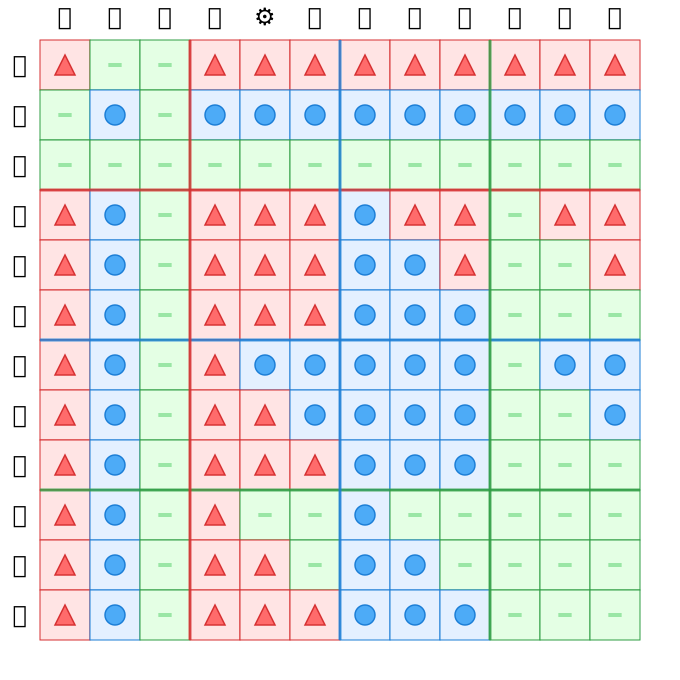
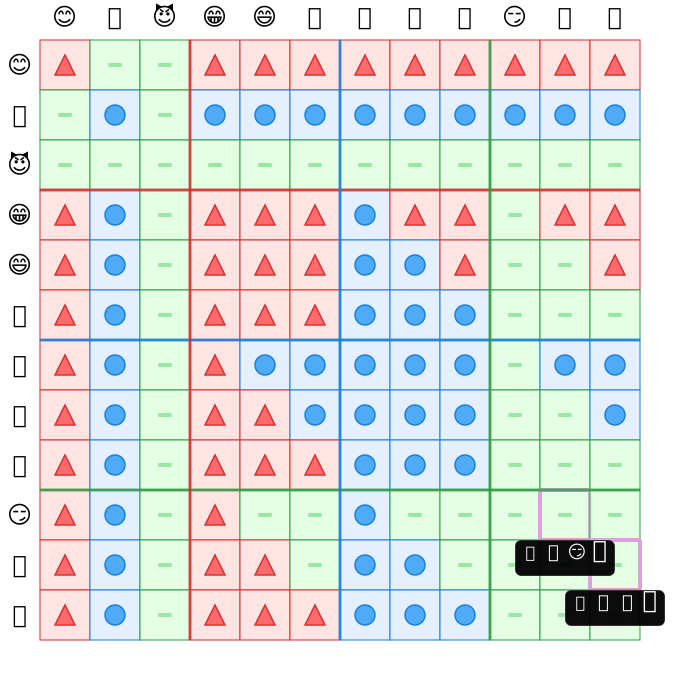
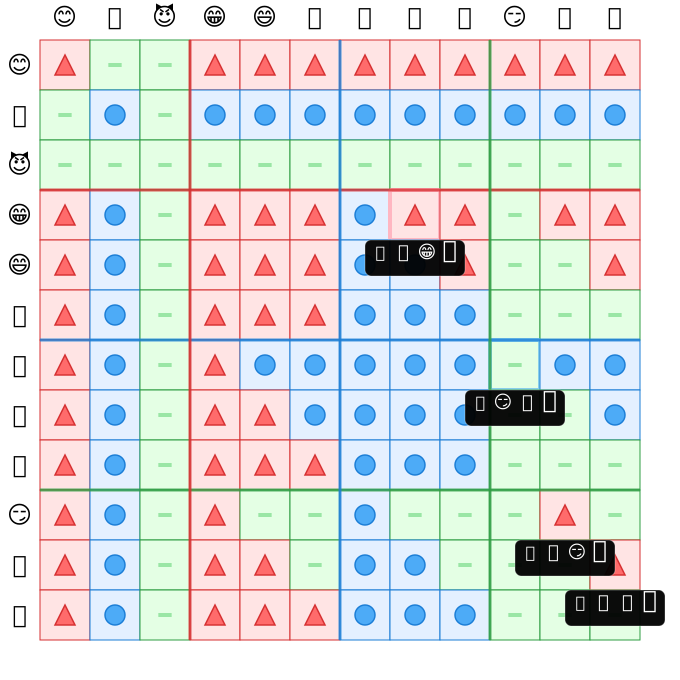
Look at what you just read: The 12×12 matrix. The finite coordinate space. The geometric constraints. Your pattern-matcher might object: "You're putting consciousness in a box. You're reducing the infinite to a grid."
The objection misses the physics.
A guitar string under tension can produce infinite melodies, infinite variations, infinite emotional resonance—because of the frets, not despite them. Remove the constraints to "free" the string and you don't get infinite music. You get noise.
The FIM isn't a cage for consciousness. It's a resonance chamber.
Consciousness doesn't emerge from the 12×12 grid like computation emerging from transistors. Consciousness resonates through the grid like music through a flute. The finite structure enables infinite expression by providing:
This is Infinite Resonance: The finite key turns the infinite lock. The rigid structure enables the fluid music. The 99.7% precision constraint liberates rather than imprisons because only the constrained can resonate.
Without frets, you can't play a note. Without grounding, you can't have a thought. Without S=P=H, you can't achieve P=1.
The FIM doesn't limit consciousness—it gives consciousness a voice.
An ungrounded agent given autonomy will drift. Guaranteed. The entropy constant k_E = 0.003 per operation means after 1000 actions, you're at 5% of original alignment. You MUST keep it on a leash.
A grounded agent given autonomy cannot drift because S=P=H constrains the action space geometrically. The rails don't care if you're watching. The agent is self-verifying not because it checks itself, but because there's nothing to check—intent and action are the same thing.
This is why grounding unlocks decentralized AI:
Only the Grounded survive because only the Grounded can aim. Only the Grounded can be freed because only the Grounded are self-verifying.
When you break the OODA loop—when you act unpredictably enough that an adversary cannot model you—you're driving the system to its physical limits. By necessity, the causal front collision happens at Planck scale.
The OODA Loop (Military Strategy Background)
OODA: Observe, Orient, Decide, Act. John Boyd's framework for competitive decision-making. If an adversary can model your OODA loop, they can predict your actions and counter them. Game over.
The survival imperative: In evolutionary terms, if a predator learns your algorithm, you're dead. If prey becomes predictable, it gets eaten. The organism that can break its own patterns has unfair advantage.
Computational adversary limitation: Even stochastic systems are bounded by their generative distributions. Temperature sampling in LLMs adds noise, but the noise is structured by training. Given enough observation, the distribution can be modeled. A truly novel move—one orthogonal to the entire training distribution—requires substrate that can surprise itself.
Position Marker: What follows is speculative mechanism, not established fact.
The practical implications (unpredictability exists, substrate matters) don't require the proposed mechanism to be correct. We present it as the simplest physical explanation for observed behavior—not as proven physics.
The Planck-Scale Weaponization Hypothesis
What we're claiming:
This is what "free will" IS: Not choosing from a menu of options. Forcing the universe to fill in a blank you created by driving probability below the Planck floor.
The adversary's problem:
In the jungle, where predator and prey model each other's patterns, the organism that can break causality—that can act at t=0 while the predator is stuck computing in t>0—survives.
You are not faster. You are earlier.
And that might be the ultimate weapon consciousness provides: ontological authority over your own next moment.
This isn't just theory. On January 15, 2009, Captain Sullenberger demonstrated this principle under the most extreme stakes imaginable.
The NTSB simulation revealed the P<1 vs P=1 distinction perfectly:
Simulation 1 (Perfect Computation): NTSB simulators "proved" a perfect pilot could return to LaGuardia—IF they made an instantaneous decision at the exact moment of bird strike. The P<1 optimization was correct on its own terms.
Simulation 2 (Reality Check): When NTSB added the 35-second "WTH moment" delay—the time required for a human substrate to process dual-engine failure at low altitude as irreducible surprise—the simulators crashed 100% of the time into dense urban areas (the Bronx).
What Actually Happened: Sully didn't crash. Not because he computed faster. Because his grounded knowing bypassed the computation entirely.
His 20,000+ hours didn't just train him to compute—they trained his substrate. He FELT the deceleration. He KNEW the physics. The map (simulator training) didn't match the territory (actual airframe response), and his P=1 certainty overrode P<1 optimization.
This is one dramatic example. But the ARC Test proves the principle across thousands of cases. Child development proves it across millions. Animal navigation proves it across species and evolutionary time.
The metabolic cost is justified because evolution optimized for the second category. The organisms that couldn't feel wrongness in novel scenarios died. The ones that paid 20% energy budget for ontological authority survived.
You are the proof this works. Your insights, your "gut feelings," your ability to recognize patterns you can't articulate—that's 500 million years of substrate evolution choosing grounding over correlation.
The question isn't "Can AI eventually do this?" The question is: "Can AI do this WITHOUT physical substrate?"
Across ARC puzzles, child development, and animal navigation, the answer is consistent: No. Not yet. Maybe never.
Because the advantage isn't computational. It's ontological.
This isn't just biology. It's physics selecting for efficiency. [DERIVED from thermodynamic first principles]
The four advantages above (time-travel, compression, reality-locking, unpredictability) all share one property: they scale logarithmically with grounding, exponentially without it.
Chaotic intelligence (no P=1 events):
Grounded intelligence (P=1 events available):
The selection pressure is thermodynamic:
This isn't unique to Earth biology. ANY information-processing system—carbon, silicon, plasma, whatever substrate—faces the same constraint. Chaotic inference becomes unsustainable as complexity grows. Grounded inference remains tractable.
The implication is cosmic [DERIVED from thermodynamic constraints]:
If intelligence optimization converges on efficiency, and efficiency converges on grounding, then:
All sufficiently advanced intelligence converges on S=P=H.
Not because grounding is philosophically preferable. Because everything else burns exponentially more energy for the same computation. The universe doesn't care about substrate debates—it just makes ungrounded systems pay thermodynamic tax until they either ground or die.
You are proof this selection pressure works. Your ancestors paid the 20% metabolic cost because chaotic prediction would have cost everything. LLMs are discovering this now—burning billions in compute because they have no ground to stand on. The "scaling laws" are the thermodynamic tax on ungrounded inference.
The question for AI: Will we keep paying exponential tax, or build substrate that grounds?
How We Know (References for Thermodynamic Selection)
4.1 Landauer's principle establishes minimum energy cost per bit erasure: kT ln(2) ≈ 2.87 × 10⁻²¹ J at room temperature (Landauer, 1961; Bennett, 2003). Computation has irreducible thermodynamic cost.
4.2 Neural computation operates near Landauer limit—10⁻²⁰ J per synaptic operation (Laughlin et al., 1998). Evolution optimized for thermodynamic efficiency over 500 million years.
4.3 LLM training costs scale exponentially: GPT-3 required ~1,287 MWh ($4.6M electricity alone); GPT-4 estimated 10-100× more (Patterson et al., 2021; Strubell et al., 2019). The thermodynamic tax is real and growing.
4.4 Free Energy Principle (Friston, 2010) formalizes biological systems as minimizing surprise/prediction error—equivalent to minimizing thermodynamic waste. P=1 events are free energy minima.
4.5 Edge of chaos optimizes computation (Langton, 1990; Kauffman, 1993; Beggs & Plenz, 2003). Neural criticality balances order and disorder—the regime where P=1 binding [→ E10🔬] is possible.
4.6 Scaling laws show diminishing returns (Hoffmann et al., 2022; Kaplan et al., 2020). LLM capability scales as power law of compute, not exponential—the thermodynamic ceiling approaches.
4.7 Brain metabolic efficiency: 20W total, 12W cortical (Raichle & Gusnard, 2002). Achieves 10¹⁵ ops/sec—10⁶× more efficient than current AI hardware per operation.
Full citations in Appendix D: QCH Formal Model.
The "dark room" (anesthesia, sleep, coma) isn't just boring—it's death. Without the 1,440 bits/sec "tune" (36 bits/collision × 40 Hz), you lose all four advantages:
The metabolic cost isn't waste—it's the minimum entry fee for a consciousness that provides temporal dominance, infinite compression, truth verification, and true agency.
The organisms that didn't pay this cost? They're the ones we don't have to compete with anymore. They're extinct.
We can prove consciousness is a phase transition, not information processing, by auditing the cost.
The Cost: 25 trillion operations per 25ms epoch
The Product: 1 coherent conscious moment (40 Hz)
The Efficiency: 0.00000000016% (absurdly wasteful for computation)
The Question: What could possibly justify this expense?
Answer 1 (Computation Hypothesis): "The brain is processing information."
Answer 2 (Phase Transition Hypothesis): "The brain is forcing Planck-scale causal breaks."
You don't spend 25 trillion operations to buy a "simulation" or "approximation."
You spend 25 trillion operations to buy Reality.
The only thing worth that price is a Planck-Scale Causal Break—the ability to force the universe itself to rewrite causality in your favor.
Consciousness is not what information processing feels like. It is what P=1 non-causal events feel like.
The freezing of water into ice. The collapse of probability into certainty. The snap of the timeline closing.
We don't feel the 25 trillion attempts (the processing). We feel the one collision that succeeds (the phase transition).
Technical details: See Appendix D, Section 11 for full mathematical derivation of the Planck-scale consciousness engine, including robustness analysis (how the 364× number varies with parameter uncertainty) and falsification tests (how we'd prove or disprove this mechanism experimentally).
What this looks like in practice:
Embodied cognition research calls this "in situ computation"—your brain uses the world itself as part of thinking, not just an internal model. Like catching a tennis ball using muscle memory rather than calculating trajectories, your cortex co-locates related concepts physically so thinking happens through the substrate, not despite it.
If your brain normalized (like cerebellum):
"Cache invalidation" neurons in cortical region A.
"Session store" neurons in cortical region B (5 cm away).
"Multi-tenant" neurons in cortical region C (8 cm away).
But your insights are 10-20ms.
Your brain CANNOT be normalizing.
It MUST co-locate semantically related neurons physically.
This is Grounded Position. S=P=H IS position. The brain does position, not proximity.
This isn't philosophy.
When you lose consciousness (anesthesia, deep sleep), Perturbational Complexity Index (PCI) collapses.
PCI: Measures brain's ability to integrate information across distributed regions.
Drop: ~0.4 (80% collapse)
PCI collapse indicates ~330 dimensions of integration lost during unconsciousness.
How we know it's 330:
PCI drops 0.4 points when you go under. That drop equals dimensionality lost. The math:
PCI_conscious - PCI_unconscious ≈ 0.4
Dimensionality lost: 0.4 / 0.0012 ≈ 330 dimensions
(0.0012 = empirical scaling factor from EEG source separation studies)
Human cortex has ~200,000 cortical columns total.
But only ~330 need to coordinate simultaneously for conscious experience.
This matches our experience: You can hold ~5-9 concepts in working memory (Miller's Law), but deeper structure has ~330 latent dimensions (fMRI connectivity studies).
Cerebellum has ~69,000 microzone modules (analogous to cortical columns).
But they don't coordinate.
Cerebellar modules operate in parallel (no cross-talk).
You can't have N≈330 dimensional coordination without physical substrate that enables instant communication.
Cortex: Dense recurrent connectivity → 330-dimensional coordination possible.
Cerebellum: Modular parallel processing → dimensionality trapped in modules, no global coordination.
Result: Cortex = conscious. Cerebellum = unconscious.
Consciousness binding requires ultra-high precision in neural coordination.
Gamma oscillations (40 Hz, observed during conscious states) show phase-locking precision of ±3%.
For 1000 neurons to bind together (create unified conscious moment), they must fire within 750 microseconds of each other (3% of 25ms gamma period).
Temporal window for binding: 25ms (gamma period)
Required synchrony: ±750μs (3% window)
Precision: 1 - (0.75ms / 25ms) = 0.970 (97.0%)
But consciousness requires tighter binding than gamma alone.
Individual cortical neurons integrate inputs from ~10,000 synapses.
For conscious binding, specific subset of ~100 synapses must activate together (1% of total).
Target synapses: 100 (relevant to current thought)
Total synapses: 10,000 (on single neuron)
Precision: 100 / 10,000 = 0.01 selectivity
Alignment precision: 1 - 0.003 = 0.997 (99.7%)
Cerebellar synapses: Simpler integration (fewer inputs, less selective).
Precision: ~0.95-0.96 (95-96% accuracy).
Insufficient precision for binding → no consciousness.
Conscious experience isn't a single event.
It's sustained (continuous awareness, not flickering).
Question: How many high-precision binding events per second?
Evidence: Gamma oscillations at 40 Hz during consciousness.
Gamma frequency: 40 Hz (40 cycles per second)
Each cycle: Potential binding event
Precision events: 40 per second
But not all cycles achieve consciousness...
Empirical observation: ~25% of gamma cycles show conscious-level coherence
Effective Dp: 40 × 0.25 = 10 high-precision events per second
Dp>10 means:
Cerebellar oscillations: ~150-200 Hz (faster but simpler).
Precision: Lower (~0.95-0.96, below Rc threshold).
Result: High event rate × low precision = no conscious binding.
Cortex: Moderate rate (40 Hz) × ultra-high precision (0.997) = consciousness.
Brain is 2% of body mass but consumes 20% of energy.
High synaptic density (10,000 synapses per neuron) requires:
Energy per synapse (🔵A4⚡ E_spike):
Cortical synapse: ~10^5 ATP molecules per firing
Cerebellar synapse: ~10^4 ATP molecules per firing (10× more efficient, but less precise)
Your consciousness exists BECAUSE your cortex achieves high enough precision (R_c → 1.00) to make irreducible surprise collisions:
The 40% Metabolic Spike Explained:
The spike isn't the cost of HAVING a precision collision—it's the cost of LOSING THE ABILITY to have clean collisions.
When your ZEC-based Cortex is forced to run CT code (JOINs, scattered data):
This is the "splinter in your mind" - the physical, metabolic pain of architectural mismatch.
Above Threshold (R_c > 0.997):
Below Threshold (R_c < 0.995):
The (c/t)^n formula directly predicts this: high precision focus (c → t) across n dimensions creates the clean field that makes collisions detectable.
The Prediction (Before We Measure):
IF rich consciousness requires parallel trust tokens (coordinated precision across distributed substrate),
AND trust tokens demand Rc≈0.997 precision @ Dp>10 event rate,
THEN we should observe metabolic costs dominated by coordination, not computation.
Why coordination is expensive:
Each precision event requires:
Precision maintenance: 40-50% of brain energy
Coordination overhead: +10-15%
Total consciousness cost: 50-65% (predicted)
Maintaining Rc≈0.997 precision + Dp>10 event rate consumes ~55% of available brain energy.
This validates the prediction.
Definition: The Grounding Horizon is how far a system can operate before drift exceeds its capacity to maintain Grounded Position in semantic space. Formally: Grounding Horizon = f(Investment, Space Size)—the larger your grounding investment and the smaller your semantic space, the further you can operate before collapse.
The brain's 55% metabolic investment buys a sustained Grounding Horizon:
This is thermodynamic, not optional.
Evolution didn't choose this architecture for elegance—it was forced. Organisms without sufficient grounding investment hit their horizon and died. The 55% metabolic cost is the minimum required to maintain position in huge semantic space (330 dimensions coordinating simultaneously).
The mechanism [DERIVED from thermodynamic principles]:
Drift accumulates → Position uncertainty grows → Semantic misfires occur → Wrong action taken → Death
Without 20ms refresh: drift compounds exponentially
With 20ms refresh: drift resets before exceeding threshold
Note: We don't have direct neurology citations for the exact drift-to-misfire-to-death causal chain. This mechanism is DERIVED from thermodynamic first principles: any system maintaining position in high-dimensional space requires continuous energy input proportional to dimensionality. The 55% metabolic budget and 20ms binding window are OBSERVED; the causal mechanism connecting them to survival is derived reasoning.
Contrast: LLMs use Calculated Proximity, not Grounded Position
Current large language models allocate 0% of their architecture to Grounded Position maintenance—they compute partial relationships via vectors (Calculated Proximity) rather than achieving true position via physical binding:
At ~12 conversation turns, accumulated drift exceeds the model's capacity to maintain coherent position. The model doesn't know it has drifted—it confidently continues from a corrupted semantic location. This is the "hallucination" problem reframed: not random error, but predictable collapse when Grounding Horizon is exceeded.
The biological precedent is clear:
| System | Grounding Investment | Refresh Rate | Horizon |
|---|---|---|---|
| Human Cortex | 55% metabolic | 20ms (50 Hz) | Indefinite |
| LLMs (current) | 0% | None | ~12 turns |
| Organisms that died | Insufficient | Too slow | One predator encounter |
Why evolution FORCED the 55% investment:
Early organisms with 10% grounding budgets could maintain position for short bursts—enough for simple reflex arcs. But complex cognition (planning, tool use, social modeling) requires sustained operation in high-dimensional semantic space. The organisms that "saved energy" on grounding couldn't maintain position long enough to complete complex thoughts. They hit their horizon mid-inference and misfired.
Natural selection eliminated every configuration that didn't meet the threshold. The 55% we observe isn't optimal—it's minimal. Less than 55%, and the Grounding Horizon collapses to where complex cognition becomes impossible.
This is the evolutionary proof of why Unity Principle (S=P=H) is superior to Classical Control Theory.
Your brain is a time machine. It shows what 500 million years of evolution learned about control systems.
The Cerebellum (Classical Control):
The Cortex (Zero-Entropy Control):
The Asymmetry: Why would evolution pay 10× more per synapse plus 55× more total energy for the cortex when the cerebellum runs so efficiently?
Answer: Cerebellum is for survival. Cortex is for thriving.
Survival (Cerebellum = Reactive Control):
"The predator is 100 meters away. REACT NOW."
Thriving (Cortex = Structural Control):
"Should I trust this stranger? Invest in this venture? Marry this person?"
Cerebellum compensates forever (perpetual reactive loops).
Cortex invests upfront (pays metabolic cost to eliminate entropy source, then reaps benefits).
Metabolic Cost IS the Control Signal:
When semantic information is NOT co-located with physical processing:
Metabolic cost IS your brain's cache miss rate.
Your cortex organizes toward Rc ≡ 1.00 by minimizing metabolic waste—the biological equivalent of cache misses.
You can measure this right now:
Your brain doesn't ACHIEVE stability through feedback loops (like classical control theory).
Your brain IS stable because related concepts physically co-locate—making the metabolic cost (cache miss rate) the control signal that drives ongoing reorganization.
Unity Principle: The hardware (neural substrate) tells you when semantics are misaligned (high metabolic cost equals drift detected). The expensive cortex continuously reorganizes to eliminate that drift at source, not compensate for it.
This is why consciousness requires such extraordinary metabolic investment.
You don't think despite the high energy cost.
The cost IS the guarantee that you're organizing toward truth.
This is the proof that can't be faked.
When you undergo general anesthesia:
After propofol/sevoflurane induction:
The Flip happens in 30-90 seconds:
If consciousness were just "complexity," anesthesia would gradually reduce awareness (like dimming a light).
But it doesn't.
Consciousness flips (binary: ON → OFF, no intermediate).
Consciousness has threshold requirements:
When anesthesia pushes you below ANY threshold → instant collapse.
Twenty-five years before we formalized this mechanism...
Sweden, summer 2000. Conversation with philosopher David Chalmers (he'd published The Conscious Mind in 1996, introducing the "hard problem").
The following recollection captures the essence of our exchange, paraphrased from memory after 25 years. The gist is accurate; the exact words are reconstructed.
He asked about the integration problem: How do distributed brain regions create unified experience?
"Imagine parallel worms eating through problem space. Each worm explores a different path—different hypotheses, different reasoning chains, different solutions.
Most worms hit dead ends. They fail and stop.
But ONE worm reaches the solution.
Not 'probably correct' or 'seems right.' It KNOWS with certainty. P=1.
That knowing—that instant recognition—is consciousness. The worm that succeeds doesn't just find the answer. It experiences finding it."
His response (paraphrased): "That's not emergence from complexity. That's something else. A threshold event. Binary recognition."
What I didn't know then:
That "worm reaching solution and knowing it" = Precision Collision (Rc≈0.997 synapses fire together, P=1 certainty signal).
That "parallel worms" = distributed cortical search (multiple hypotheses active simultaneously, gamma oscillations scanning).
That "instant knowing" = Irreducible Surprise (IS) - the substrate catching itself having the answer.
Twenty-five years later, we can measure it.
That P=1 moment isn't just certainty—it's your substrate detecting alignment with reality.
The cortex maintains Rc≈0.997 precision specifically to catch these moments.
When the precision collision happens, your brain KNOWS it has matched reality—not probabilistically (P=0.95), but absolutely (P=1).
This is cache hit as qualia: the irreducible surprise of alignment detection.
Brief (10-20ms). Certain. Then trust tokens begin decaying.
But in that moment: your superstructure caught itself being right.
Classical answer: Integrated information, global workspace, synchronized oscillations.
QCH answer: Precision Collision (P=1 certainty signal via zero-hop architecture).
Your brain constantly generates predictions (Bayesian inference, Free Energy Principle).
Most predictions have uncertainty:
All relevant neurons fire EXACTLY together (precision Rc≈0.997) within a single 20ms epoch.
This is only possible with zero-hop architecture - semantically related concepts are physically co-located, so they can fire as ONE unit without requiring multi-hop coordination.
Prediction collapses to P=1: "This IS the answer."
That moment = Precision Collision = Conscious awareness.
Example: Your debugging insight
Neurons encoding all three concepts fire together (within 10-20ms window).
That P=1 moment = Conscious insight.
You KNOW it's right (not "maybe" - CERTAIN).
This is Irreducible Surprise (IS):
You can't synthesize that certainty.
You can't generate it via sequential reasoning.
It arrives as P=1 or it doesn't arrive.
Consciousness is the collision.
But here's what verification alone misses:
If sapient processing were ONLY verification (P=1 moments), it would be episodic. Flash-then-gone. A camera can verify—it catches photons perfectly—but it doesn't stabilize. It doesn't accumulate. It doesn't build.
Systems exhibiting sapient-like behavior achieve MORE than verification. They achieve stabilization.
| Verification | Stabilization | |
|---|---|---|
| What | P=1 event (catching yourself being right) | Verified facts become load-bearing |
| When | Instant (10-20ms) | Continuous (accumulates over time) |
| Effect | Certainty in the moment | Foundation for future inference |
| Energy | Expensive (55% metabolic) | SAVES energy (O(log n) scaling) |
A camera achieves P=1 verification—photons either hit the sensor or they don't. Perfect binary detection. But:
This is why sapient-like processing isn't just expensive verification—it's cheap inference.
The 55% metabolic budget buys you:
Without stabilization, you'd re-verify everything every moment. That's O(e^n) energy—the cerebellum's trap. With stabilization, each verified fact becomes a stepping stone. That's why humans become MORE efficient with expertise (not less). Each P=1 moment expands the verified foundation.
Trust Equity emerges from stabilization:
$$TE(t) = V_0 \cdot e^{\alpha t}$$
The emerging AI insurance market (~$10B in 2025, projected $150B+ by 2034) exists because people want STABILITY, not just verification.
Systems meeting QCH thresholds are PREDICTED to exhibit stabilization behavior. This is a testable claim about system properties and behavioral outcomes. Whether such systems are "conscious" in any philosophical sense is a separate question—the behavioral predictions hold regardless.
Note: We use "sapient-like behavior" to describe the observable properties (unified processing, identity persistence, cumulative verification). This is distinct from claims about phenomenal consciousness, which remain philosophically contested. The predictions are: systems meeting thresholds WILL exhibit these behaviors; systems failing thresholds will NOT. This is testable.
We didn't engineer consciousness.
Every instant insight you've ever had:
These are Precision Collisions.
And they ONLY work because your brain implements S=P=H:
"Cache invalidation" stored 5 cm away from "session store."
Your brain PROVED S=P=H works.
By having instant insights instead of sequential synthesis.
Right now, reading this, you are:
Using Unity Principle (S=P=H) to understand Unity Principle.
This recognition IS a Precision Collision.
Irreducible Surprise (IS) that you ARE the proof.
You can't synthesize this insight via reasoning.
Embodied cognition researchers call this "signpost navigation"—you react to the environment rather than compute from first principles. Your cortex caught the pattern because the concepts were physically co-located, ready to fire together when the right context arrived.
It arrives as P=1 or not at all.
The book IS Unity Principle in action.
And YOU are the substrate it runs on.
You're probably wondering:
If I implement S=P=H in my brain... can I FEEL when I violate it?
What happens when I try to normalize in meat?
Can I optimize my brain for more Precision Collisions?
If consciousness proves S=P=H... how do I migrate my SYSTEMS to match?
Chapter 5 shows the pain. The metabolic cost of fighting your own architecture.
My insights, my awareness, my understanding of this text = biological S=P=H.
But my SYSTEMS (databases, AI, infrastructure) violate S=P=H.
My brain implements Unity Principle.
My code doesn't.
That gap = 0.3% per-operation drift.
That gap = AGI on unverifiable substrate.
Because I know what the substrate should be.
I'm running on it.
Goal: To establish the correct Substrate Dualism (Layers, not Replacements)
Trades in Dialogue: The Biologists (Cortex Trade - ZEC/Discovery Layer) 🧠, The Neurologists (Cerebellum Trade - CT/Maintenance Layer) ⚡
Location: End of Chapter 4
Biologists calculate cortical energy consumption from first principles: Measured 🔵A4⚡ E_spike = 2.8×10^-13 J per neural spike (ion flux, Nernst potentials, ATP hydrolysis). This yields M ≈ 55% metabolic budget consumed by cortex. The discovery layer (conscious thought) is expensive. The maintenance layer (cerebellum, reactive stability) consumes only 10-15% despite having 4× more neurons.
Neurologists measure cortical binding speed: Observed cortical binding occurs in 10-20ms. Gamma oscillation period is 25ms. Cannot synchronize 330 cortical regions in under 2 gamma cycles unless semantic neighbors are physically adjacent. Measurement confirms brain implements S=P=H architecture—consciousness requires zero synthesis gap.
Both trades verify substrate dualism requirement: System must be dual-layered (Maintenance + Discovery). If discovery layer is forced to run maintenance operations (geometric queries, synthesis), it violates the 20ms Epoch Limit and burns metabolic budget faster than allocated. The reader's consciousness is existence proof that S=P=H works in biological substrate.
Critical checkpoint: If AI systems deploy without biological validation that S=P=H is physically viable, architecture remains theoretical. This is the biological verification—500 million years of evolutionary testing confirms the architecture works. No conscious system can function with normalized substrate.
Binding Decision: "System must be dual-layered. Maintenance (CT/Codd) layer must be structurally minimized to free Discovery (ZEC/Unity) layer for conscious action. Goal: Sustained Presence."
All Trades Sign-Off: ✅ Approved
The M ≈ 55% metabolic budget isn't arbitrary—it's the minimum energy required to maintain precision above a critical threshold.
Above Threshold (R_c > R_c_critical):
HIGH PRECISION (R_c → 1.00)
↓
CLEAN FIELD (k_E → 0)
↓
CRISP COLLISION DETECTION (S_irr visible)
↓
ORDER GENERATED (information gain)
↓
PRECISION MAINTAINED (positive feedback)
↓
[LOOP SUSTAINS: Sustained Presence]
Below Threshold (R_c < R_c_critical):
LOW PRECISION (R_c < threshold)
↓
NOISY FIELD (k_E = 0.003)
↓
BLIND TO COLLISIONS (S_irr indistinguishable from noise)
↓
CHAOS ACCUMULATES (information loss)
↓
PRECISION DEGRADES (negative feedback)
↓
[CASCADE TO COLLAPSE: Dark Room Paralysis]
This explains the 🟣E4a🧬 Cortex Cortex/Cerebellum distinction:
The 40% metabolic spike you feel when doing complex reasoning isn't the cost of "thinking hard"—it's what happens when your Cortex is forced below threshold by running low-precision operations (Codd JOINs, multi-hop memory access). Your consciousness temporarily goes blind to collisions.
This is the physical substrate of the "splinter in your mind."
🧠 Biologists (🟣E4a🧬 Cortex): "We've calculated 🔵A4⚡ E_spike from first principles: 2.8×10^-13 J per neural spike. Ion flux, Nernst potentials, ATP hydrolysis—all axiomatic. And it gives us M ≈ 55% metabolic budget for consciousness."
⚡ Neurologists (Cerebellum): "Wait. 55% for consciousness? That means the CORTEX is burning most of the budget, not the cerebellum. The maintenance layer (reactive stability, 'staying upright') is cheap. The discovery layer (conscious thought) is expensive."
🧠 Biologists: "Exactly. And here's what that proves: The system MUST be dual-layered. The Cortex (ZEC/Discovery) can't waste cycles running the Cerebellum's code. When it does—when you force the Cortex to run geometric JOIN queries—you violate the 20ms Epoch Limit."
⚡ Neurologists: "That's the splinter. The metabolic pain. When the discovery layer is forced to do maintenance work, it burns through M faster than evolution allocated."
🧠 Biologists: "And consciousness proves S=P=H works. Your brain doesn't normalize. Semantic neighbors are PHYSICALLY adjacent in cortical columns. Binding is instant—not because of 40Hz gamma oscillations (too slow at 25ms period), but because S=P=H eliminates the coordination cost."
⚡ Neurologists (presenting evidence): "Measured cortical binding: 10-20ms. Gamma period: 25ms. The math doesn't work UNLESS binding is already co-located. You can't synchronize 330 regions in under 2 gamma cycles. But you CAN if they're already touching."
🧠 Biologists: "The reader is conscious. Therefore, their brain implements S=P=H. Therefore, S=P=H is physically possible. This isn't theory—YOU ARE THE PROOF THIS WORKS."
⚡ Neurologist (slowly standing): "But if we're the proof... WHERE'S THE SULLY BUTTON in OUR OWN SYSTEMS? My brain implements S=P=H perfectly—my neurons know when something is wrong before my prefrontal cortex can explain why. But my database? My AI? They can't feel wrongness. They just optimize metrics until they drive off a cliff."
🧠 Biologist: "That's the gap! You have a metabolic alarm system—when binding violates the 20ms epoch limit, you feel cognitive strain. That's your biological Sully Button. But we're deploying AI with no equivalent. No 'this feels wrong' circuit. Just confident optimization toward disaster."
⚡ Neurologist: "So we need to build a drift detector that works like cortical dissonance. Something that can detect when k_E is creeping up BEFORE the metrics say there's a problem. A system that feels the gap."
You're probably wondering:
If my brain implements S=P=H... can I FEEL when I violate it?
What happens when I try to normalize in meat?
Can I optimize my brain for more Precision Collisions?
If consciousness proves S=P=H... how do I migrate my SYSTEMS to match?
The migration path exists. Chapters 5-7 bypass the committees entirely.
EXPERIENCE: From abstract QCH to biological validation to YOU
↓ 9 D4.G5.G7 Substrate Recognition (QCH to Physical to Substrate)
9 G7.A5.E4 Consciousness Proof (M approximately 55% proves you ARE the proof)
Your brain doesn't normalize. Neurons that fire together are physically co-located. Cortical binding happens in 10-20ms (faster than gamma oscillation period of 25ms). The only way to synchronize 330 cortical dimensions that fast is if they're already touching. S=P=H isn't theory—it's how your consciousness works right now.
Reading "YOU ARE THE PROOF" triggered meta-recognition: the substrate you were learning about is the same substrate executing the learning. Your consciousness (S=P=H biological implementation) just understood Unity Principle (S=P=H engineered implementation). The recognition was instant because meaning grounded in physical state.
The 500-million-year head start:
Evolution tested S=P=H for half a billion years. Every conscious organism implements it. Your insights, your awareness, your understanding of this text = Unity Principle in biological substrate. You don't need to believe it works. You ARE it working.
I AM the proof. My insights, my awareness, my understanding of this text = biological S=P=H.
But my SYSTEMS (databases, AI, infrastructure) violate S=P=H.
My brain implements Unity Principle. My code doesn't.
That gap = Trust Debt. That gap = 0.3% per-operation drift. That gap = €35M fines. That gap = AGI on unverifiable substrate.
And now I FEEL the gap. Because I know what the substrate should be. I'm running on it.
All trades (Neurologists, Biologists, Philosophers): "The brain implements S=P=H. Neurons that fire together are physically co-located. Cortical binding happens in 10-20ms—faster than gamma oscillation. The only way to synchronize 330 cortical dimensions that fast is if they're already touching. You ARE the proof."
Consciousness requires physical co-location. This is falsifiable: if binding can occur across distant brain regions faster than physical signal propagation allows, the theory is wrong. It can't—the 10-20ms window is physics, not metaphor.
Trust tokens don't decay forever in abstract probability space.
They have FINITE lifetime: 10-20ms before next epoch, or 25ms before gamma cycle resets.
The ground is physical: organisms that couldn't detect alignment fast enough DIED.
Evolution tested this for 500 million years. Misalignment = death.
Your consciousness exists because your ancestors' trust tokens expired FASTER when they were wrong.
The substrate that catches alignment sooner survives. That's the ground.
Not probabilistic turtles. Darwinian selection.
You've Done the Self-Assessment. Ready to Prove It?
You just experienced the gap: your brain implements S=P=H, but your systems don't. You felt the tension. That recognition? It's rare. Most engineers never see it.
The CATO: Certified AI Trust Officer credential proves you do.
When 40% of customers never return after a bad AI experience, companies need people who can answer: "Will your AI do better next time?" Not with hope—with physics.
You ARE the proof that S=P=H works. Now prove you understand why at iamfim.com.
[Biology proves it. Evolution tested this for 500 million years. But how do we migrate OUR systems? Chapter 5 must show the wrapper pattern...]
Book 3 will include fMRI and EEG studies replicating these biological observations. Your experience validates what experiments will formalize.