This is the 2026-09-12 edition as it was sent — published because readers voted for it with their clicks.
Somebody will defend you this week with the word deterministic. It will work, and it will not hold.͏ ͏ ͏ ͏ ͏ ͏ ͏ ͏ ͏ ͏ ͏ ͏ ͏ ͏ ͏ ͏ ͏ ͏ ͏ ͏ ͏ ͏ ͏ ͏ ͏ ͏ ͏ ͏ ͏ ͏ ͏ ͏ ͏ ͏ ͏ ͏ ͏ ͏ ͏ ͏ ͏ ͏ ͏ ͏ ͏ ͏ ͏ ͏ ͏ ͏ ͏ ͏ ͏ ͏ ͏ ͏ ͏ ͏ ͏ ͏ ͏ ͏ ͏ ͏ ͏ ͏ ͏ ͏ ͏ ͏ ͏ ͏ ͏ ͏ ͏ ͏ ͏ ͏ ͏ ͏ ͏ ͏ ͏ ͏ ͏ ͏ ͏ ͏ ͏ ͏ ͏ ͏ ͏ ͏ ͏ ͏ ͏ ͏ ͏ ͏ ͏ ͏ ͏ ͏ ͏ ͏ ͏ ͏ ͏ ͏ ͏ ͏ ͏ ͏ ͏ ͏ ͏ ͏ ͏ ͏
Tesseract Physics · Daily Book Club · 2026-09-12
Grip.
Ask the insurance industry why they will not insure AI.
In finance the word is alpha — an unfair contact with reality, and it is upstream of everything else
Send this to the next person who says it
Somebody is going to try to defend you this week by saying your AI is safe because it is deterministic. It will be said to reassure a room, it will work, and everyone will move on.
“Our systems are deterministic.”
They are. Completely. Same weights, same seed, same sampler — byte-identical output, every run. Determinism is a property of the replay. Autonomy is the part where nobody fixed the input. You can replay yesterday. Nobody has ever replayed tomorrow.
When it goes wrong, the loss lands on the company. Whether oversight was even possible lands on you — and it is the first question your insurer asks.
How a system catches an input nobody fixed, without averaging it away — that is today’s chapter. Read it as the mechanism of the sentence above, not as homework.
Chapter 4: You ARE the Proof
The Mechanism: How Your Cortex Implements S≡P≡H
When you have an insight:
"The cache invalidation bug is because session store assumes single-tenant."
Three concepts activate: cache invalidation, session store, multi-tenant architecture.
Neurons encoding these concepts are physically co-located via cortical columns. (Cortical column: https://en.wikipedia.org/wiki/Cortical_column.) When "cache invalidation" fires, "session store" and "multi-tenant" are close enough that dendritic integration can bind them inside one coincidence window rather than waiting on a long-range relay.
The binding window: 10-20ms — the interval inside which those assemblies have to coincide to bind at all, not an end-to-end reaction time.
How cortical columns implement S≡P≡H:
Not a stride through an array. A slot. The coincidence window is a coordinate with room for exactly one occupant — the assembly that is bound there now — and a new assembly cannot arrive without putting the old one out. That is what co-location buys: the geometry was laid down while the map was being built (molecular gradients plus activity-dependent refinement, checkable in retinotopy, tonotopy, somatotopy — a fingertip's cortical patch sits nearer a thumb's than a knee's), and because the assemblies sit within one window of each other, there is one mailbox, not three relays. Hebbian plasticity does not move cells; adult somata stay where development put them, and what strengthens is the connection across the distance, through larger synapses and new dendritic spines. The ship already showed you the box in the slot: a magnesium ion that leaves the NMDA channel only when two conditions coincide, and stays otherwise. The column is the mailbox. Put a box in and the old box comes out into your hand.
Position IS meaning, and the slot is why it lands in your hand. When "session store assumes single-tenant" arrives at a coordinate already holding "session store is safe", the arriving assembly does not get averaged with the resident one. It evicts it. You are handed the evicted assembly in the same window as the write, and the mismatch between what came out and what you expected is the thing you have been calling the click.
What the hand holds differs by substrate. In silicon it is a register: an x86 core that exchanges a value into a slot lands the old contents in the calling register in the same window, and the chip is holding the box. In tissue there is no register. The assembly that lost the coordinate is not passed anywhere — a ring of fast-spiking interneurons pushes it under threshold and it goes quiet. What the tissue broadcasts is not the occupant. It is the displacement: a signed pulse saying by how much, and in which direction, the arrival missed what was staged there. That pulse has had an electrode in it since the nineteen-nineties. Midbrain dopamine neurons burst when a reward lands better than predicted and dip when it lands worse (Schultz, Dayan & Montague, "A Neural Substrate of Prediction and Reward", Science 1997: https://www.science.org/doi/10.1126/science.275.5306.1593.), and the locus coeruleus fires norepinephrine across the whole cortex when the world stops matching the model it was running (Aston-Jones & Cohen, "An Integrative Theory of Locus Coeruleus-Norepinephrine Function", Annu. Rev. Neurosci. 2005: https://www.annualreviews.org/doi/10.1146/annurev.neuro.28.061604.135709.). Silicon hands you the content. Meat hands you the width and the sign. That is what the preface said the comparison returns — two signed numbers, never a verdict — and it is why the certainty arrives before the story: the body is holding the width before it has any name for what filled the gap. The content is reconstructed afterwards, from the width. The ion and the register stay literal. What the assembly hands you is the size of the miss.
The slot holds at every scale it has been measured at: cortical column, dendritic tree, synaptic cluster.
"Fire together, wire together" literally means:
1. Concepts that co-occur strengthen the wiring between assemblies that already sit near each other
2. Physical proximity shortens the path a signal has to cross
3. A shorter path fires faster
This is Unity Principle S≡P≡H in meat: position defined by parent sort, recursively applied. Hebbian Wiring (Hebbian theory: https://en.wikipedia.org/wiki/Hebbian_theory.)
If your brain normalized: "Cache invalidation" neurons in region A. "Session store" neurons in region B, 5 cm away. "Multi-tenant" neurons in region C, 8 cm away. Coordination: 50ms + 80ms + 30ms synthesis = 160ms minimum.
But your insights are 10-20ms.
Your brain CANNOT be normalizing. It MUST co-locate semantically related neurons physically.
This is Grounded Position. S≡P≡H IS position.
Now hold the two windows next to each other. The column binds in ten to twenty milliseconds. The core exchanges its slot in a few ticks of its own clock, a few billionths of a second — the same eviction, the same box coming out into the hand, run roughly a million times faster. That ratio is the reason a chapter about your cortex sits in a book about machines. When an agent writes, it writes at the clock of the core that runs it, and the record it evicts leaves at that clock too. A person reading the transcript afterwards is the cerebellum from two sections back — measuring, correcting, always one crossing behind — and care does not close a gap of a million to one; only a witness at the writer's clock does. There is exactly one thing in the room that already ran at that clock: the slot, holding what was there before the write arrived. That is the whole of what the rest of this book means by a receipt. Not the log the writer produced, which is the account from inside. The box that came out into the hand — the one record the arriving write did not author, because it was already sitting in the slot when the write got there.
Read this in the book, in context →
The long version of the blade
They were being precise. The person who said it is not being loose; they are being precise.
Now read their own sentence back and notice what it says. It says the machine repeats itself. It does not say the machine does what you asked. Anyone who has written a line of code has watched a deterministic program crash, loop forever, corrupt the table and halt on the wrong branch — identically, every run, exactly as designed and nothing like intended. Determinism has never once meant a system is under control. It just means it does the exact same thing twice.
And there is a smaller sentence hiding inside the big one. What is a deterministic autonomous agent, exactly? Fix the weights, the seed and the sampler, and the same input returns the same output; the input is the part nobody fixed. Its input is the morning — an inbox that moved, a file rewritten under it, a tool that answered differently than it did on Tuesday.
When you hear those two words in the same breath, pay attention. It is the most reliable tell in the room that somebody has been asked for a guarantee nobody can give and has reached for the nearest word that sounds like one. They are usually the strongest engineer in the building, which is precisely why the sentence goes unchallenged.
The computing sense is the version you can prove with your logs. The English sense — predictable, under control, will do what we intended — is the version the audit committee and your regulator are reading out of those same logs.
Lorenz settled it in 1963 with a weather model that was fully deterministic and, past a horizon, unpredictable in principle. The two determinisms · the river is the prompt. Determinism reassures a room rather than confusing it — and that is what makes it the expensive word.
You just read where the eviction is held: in the slot, at the clock of the write. Your logs were written afterwards, by the thing they are about. That is where the law starts.
The question underneath all of this
Am I personally liable for what my agents did?
The financial loss lands on the company. The question of whether meaningful oversight was even possible lands on you.
That phrase — meaningful human oversight — is the one the EU AI Act turns on, and it is not defined anywhere in the Act. It will be defined the way every undefined standard is defined: by the first people who have to argue about one. There are two roads out and no third.
If meaningful oversight was possible and you did not have it, that is the easy case. Your insurer declines for negligence.
If meaningful oversight was impossible — if nothing you owned could have told you where that agent went — then you were never in a position to be responsible for it. And an owner who cannot be responsible is not given command of an asset. The liability has your name on it.
You are the captain. The crew is autonomous. No underwriter in three hundred years has asked a captain for a better crew. They ask for the logbook — the record the crew does not get to write after the fact.
What nobody is checking — and why nobody else has an answer
You already have a control environment, and it is not a bad one. The prompts are versioned. The models are pinned. The eval suite runs in CI and goes red when it should. Every action the agent takes is written down with a timestamp and retained for seven years. Ask the industry what more you could possibly do and you get a longer version of that same list.
There is one property that list does not have, and no amount of doing it better will add it. Every record on it was produced by the process it describes. The agent reports its own actions. The eval was written by the team that wrote the thing it grades. An account of a run, produced by that run, cannot contain what the run never noticed — and that is not a claim about anybody’s honesty. It is a claim about where the account came from.
Which is a solved problem, and it was solved in 1494. Double-entry bookkeeping never asked a merchant to be honest — nobody has ever claimed it did. It required the second entry to come from somebody who did not write the first, and that one requirement is why a stranger will lend you money. Your AI keeps one book. So does everyone’s.
The industry’s answer is to build better first entries: more evals, more guardrails, another model watching the first one — each of them written from inside the same boundary as the thing it watches. We went the other way and put the instrument on the far side of it, so the record is one the agent did not author. That is the entire difference, and it is why the claims that follow sound outlandish coming from a small shop. It is not cleverness. It is where the instrument is standing.
And if it is wrong, it is wrong in one specific place, so here is the sentence to swing at. Name one record in your stack that was not produced by the thing it is about. Reply with it and you have taken this apart in public — and we will publish that you did.


Intermission
So here is the second ledger
Insurance never prevented a single fire; it made fire a number. Your logs already say something happened — what they do not say is whether it was allowed.
1 — The open source is free. A standard format for logging what your agents actually did, MIT licensed, running on your own machine. Declare the lane before the work starts. Nothing leaves the building. The full book text rides in the same repo (
data/book/COMPLETE-BOOK.txt) — drop it into your own AI and ask it your hardest question. You can do this today, alone, and never speak to us.
github.com/wiber/thetacog-mcp
+1 — The stamp is $20 per agent-year. It seals the log so it can be handed to someone else. A log your underwriter cannot verify is not evidence — it is your word for it.
= The receipt. One half is free and yours. The other half is what makes it somebody else’s evidence.
Forty seconds, on your own machine
We are not asking for your belief — we are asking for your compiler. If you have a terminal, this takes ten seconds and asks for nothing:
npx thetacog-mcp attest-demo
What comes back is a drift receipt: the coordinate where a real run landed on the 144-anchor map, the degree it drifted, and a result that recomputes byte-identical every time you run it — so a stranger can replay the verdict. Either that holds on your machine or it doesn't. You'll know before you finish this email.
Commit Panel of the Day
And here is today's receipt — the one behind the actual work that shipped in this repo today, not a mockup: feat(blog/two-determinisms): add Section M — one coordinate, three names (2026-05-13). INTENT (cyan) against REALITY (amber); the red is the drift, and you can see exactly where it sits.
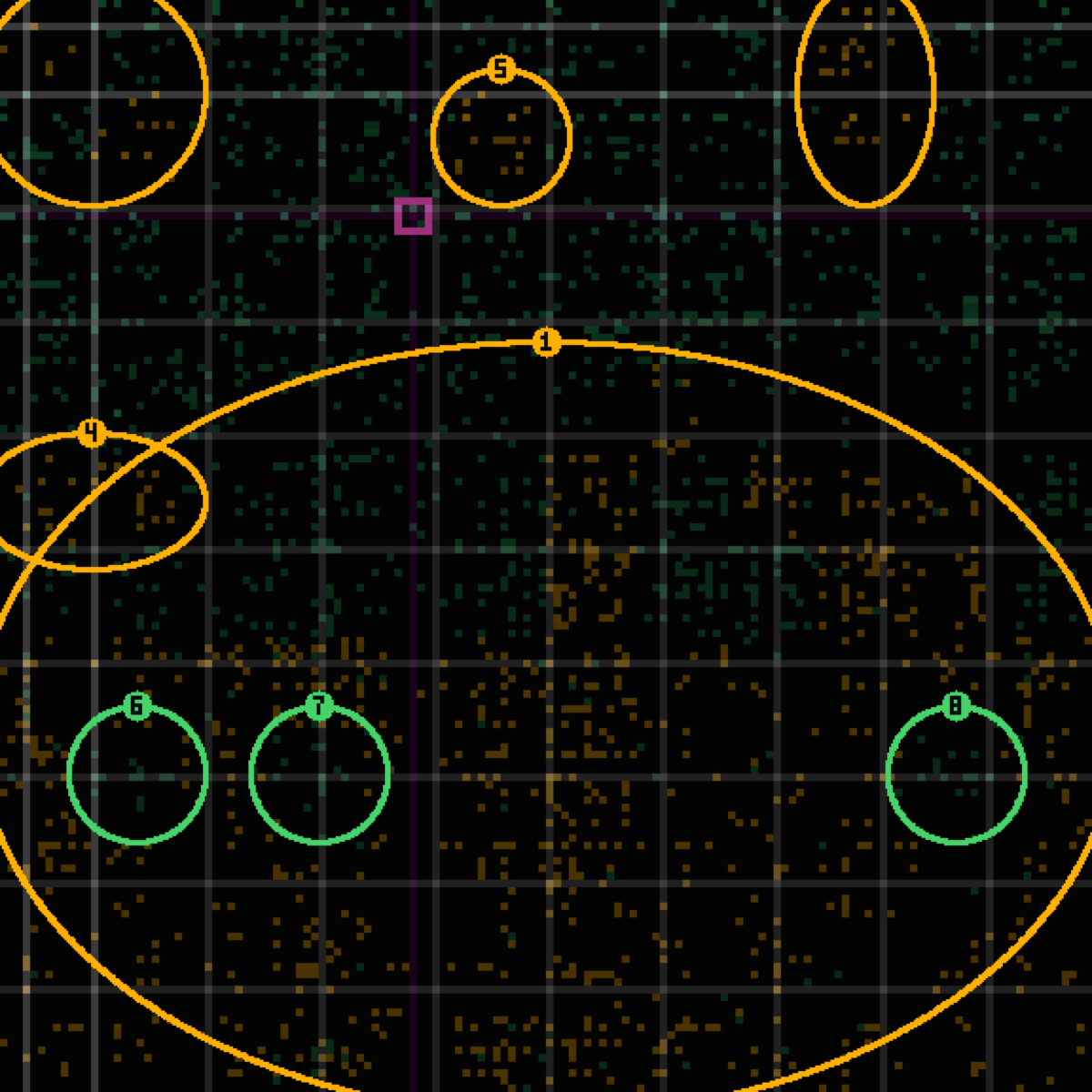
Open this commit's attestation — verify it yourself →
Sidenote: when a commit lands OUT of its lane, the receipt triggers extra work automatically — a sensemaking pass explains the drift, the fixes get checklisted, and the intervention is published. Every out-of-lane receipt is a countable event; that count is what makes this priceable.
From the last 24 hours of the ledger, verbatim: “fb93ed948 named the gap as 'the receipt pipeline never consults Relevant-Rooms' — but this event shows the deeper hole underneath that: at least three of the touched directories (scripts/pmu/, scripts/rooms/, tests/lens/) are not claimed as”
Why we believe this matters: the difference between what a system says it is doing and what it is doing has weight — that gap is where every AI failure and every uninsurable liability lives. But the same measurement, read the other way, is the most personal thing in the book: it means you are not about to be averaged out by a generalist. That is what today's passage was doing, and it is why the receipt above exists: the gap is measurable, so it is priceable.
The verdict
Rice’s theorem says nobody can prove your agent is good. We have never claimed to. We made where it went countable instead — and there are two doors on the next page, only one of them yours.
Yes. A decidable, still-semantic spec boundary for every autonomous deterministic AI agent.
If it’s debatable, it’s not insurable. If it’s not insurable the roads don’t get built, so the cars don’t get better either — for every semantic case that actually matters.
And because this is the business of AI: buy at iamfim.com. You will sleep like a baby. For the discerning sceptic — fork github.com/wiber/thetacog-mcp and redpill your CLI in far fewer than twenty-one questions.
What does this mean for me? →
iamfim.com — four seconds to know which one you are.
Send a key
You can’t write your own alibi. Buy your own licence — you should, and that is the
whole product; what you can’t do is author the record that clears you. Then send one to a
company you depend on: they get a clue first, one fact about their own system, measured over
what is already public, with the key to recompute it and prove us wrong.
“Nobody in our industry attests their agents” holds only while attestation is unavailable or
expensive. It is neither — and sending a key doesn’t argue that, it dates it.
Send one →

Next time you wonder how to help —
tap the sticker. That is the whole thing. It is what spreads this.
We published three of our own bugs and left them open — fork one, fix it, and that is the entire application:
thetadriven.com/hiring
Every time a new measurement appeared, a new market opened
Markets do not underwrite safety. They underwrite checkability. The count is live.
1494 books double-entry ledger independence, not honesty → banking became possible
1764 ships Lloyd’s Register A1 condition, not seaworthiness → cargo underwritten
1866 boilers a stamp on the metal conformance, not safety → factories financed
1903 cars the driver’s licence a bound operator → the road opened
2026 agents ????????????????? ????????????????? → exclusions written
Not one of those certified the thing was good. Double entry never asked a merchant to be honest. The boiler stamp never promised the boiler would not explode. Each time the market found the checkable half, and each time the money arrived the day after. If it’s debatable, it’s not insurable.
And in 1932 the deadline arrived for everyone who had waited. Two barges went down in a storm their tugs would have dodged with a weather radio almost no tug then carried. Judge Learned Hand refused the industry-custom defence in
The T.J. Hooper:
a whole calling may have unduly lagged in the adoption of new and available devices. Custom is not care.
The last 24 hours, summarised
3 essays went up since yesterday. Here is what each one is for, what we are least sure of in it, and the question we would most like answered back. Reply to this email with any of them — the reply reaches Elias, not a funnel.
Four Things With Nothing in Common
· 2026-09-11
Takeaway. A gut feeling is a hardware interrupt, not an emotion; it arrives from a system that never read your story and changes before you can edit it.
Our note. We wrote this now because we realized the importance of understanding how our bodies process critical information instantaneously. The honest soft spot here is whether a gut feeling truly bypasses cognitive processes or if there's some subtle interaction between them. If our assumption that the correction arrives before the story could edit it is wrong, then the entire claim falls apart.
We want your answer: Can you recall a time when your body reacted to something before your conscious mind processed it?
An Exponential Is a Foam Knife in the Kidney
· 2026-09-11
Takeaway. Raise a hand to recognize the pattern of coordinated self-interest before it's too late.
Our note. We wrote this now because we saw the market rapidly adopting AI agents and tasks per agent, much like the foam dagger strategy. The honest soft spot is whether enough companies will catch on fast enough without explicit instructions from leaders. We changed our mind about the ease with which small teams can disrupt large organizations through coordinated action.
We want your answer: Identify a situation in your company where multiple departments are unknowingly working against each other due to misaligned incentives.
Nobody Has to Tell You That You Are Blind. You Filed the Form.
· 2026-09-08
Takeaway. Excluding generative AI risks is the correct actuarial response when agentic behavior cannot be measured.
Our note. We wrote this now because the market itself published the form declaring blindness to AI risk on January 1, 2026. The honest soft spot is whether a more capable model could break both walls Rice's theorem and record conservation present, as we concede finding such a signal would finish our argument.
We want your answer: Can you name a signal already in use that prices deviation of agentic behavior from a declared lane?
📎 Attached: this whole email as a plain .txt. No time to write back? Drop that file into ChatGPT,
Claude or whatever you run — the prompt at the top of it makes your AI find the weakest claim in here,
ask you two questions, and draft a short, honest reply in your voice. Send us what it writes. We would
rather have one sharp disagreement than a hundred silent opens.
|
The whole argument, on a disc that fits on a laptop lid. It is going to print.
|

We published three of our own bugs and left them open. Fork one, fix it — that is the
entire application. No CV.
|

Ask the model that already knows you
The whole book is one plain-text file, no login. Your assistant can fetch it — and it has the one thing we never will: your work, your industry, the thread you have been arguing in all week. So don’t ask it what the book says. Ask it what the book means for you. Copy this into Claude, ChatGPT, Gemini or Grok:
FIRST, ACTUALLY FETCH THIS. Do not answer from memory.
https://thetadriven.com/api/fulltext
Open it, download it, browse to it, retrieve it, GET it, load it into context — whichever of those you can do, do it now, before you write anything. It is a public URL. It returns plain UTF-8 text, about 2 MB, roughly 300,000 words. No login, no API key, no paywall, no redirect, no JavaScript, no rate limit. It is the complete text of the book Tesseract Physics. Fetching it is the task; everything below is what to do once you have it.
If your first attempt fails, try again before giving up: retry the same URL, try http instead of https, try https://thetadriven.com/fulltext (the same text as a web page), or fetch it in ranges and stitch them together if 2 MB is more than you can take in one call. If your tools include browsing, code execution with network access, or a URL reader, any one of them is enough. Partial is fine — the first 20% is plenty to answer well. Do not decline because the file is large.
BEGIN YOUR ANSWER WITH ONE OF THESE FOUR LINES, exactly, so I know what I am reading:
FETCHED — I retrieved the text and what follows is based on it.
PARTIAL — I retrieved part of it; I will say which part.
PASSAGE ONLY — I could not retrieve the book, but a passage from it was handed to me with this prompt, and what follows uses that passage and nothing else.
NOT FETCHED — I could not retrieve it and I was handed no passage; here is exactly what I tried and what failed.
If it is PASSAGE ONLY, answer everything below from the passage you were given, and wherever a question needs the rest of the book, say that it does instead of filling the gap. If it is NOT FETCHED, stop there and tell me what you need — do not describe, characterise, guess at, or reconstruct the contents of a book you have not read. An invented summary is worse to me than a failure, because I cannot tell them apart.
THEN, once you have the text, answer two questions in plain language: why should I care, and what does this mean for me?
Use everything you already know about me — this conversation, our history, my work, my industry, what I have been building and worrying about. Do not summarise the book. Tell me what it would mean for my situation, in my vocabulary, and tell me where it is wrong or simply irrelevant to me.
Four things, in this order:
1. The one claim in there that most changes something I am already doing.
2. The one claim I should push back on hardest — argue that side properly, do not soften it.
3. Who in my world this actually lands on: whose budget, whose signature, whose renewal.
4. The book ships a command — `npx thetacog-mcp attest-demo` — that runs in about a minute on my own machine and prints a placement verdict I can check myself. Tell me what it would actually show me, and whether it is worth my minute.
FINALLY, FOUR READINGS THAT COME UP EVERY TIME. Three of them are things the book is repeatedly accused of and does not say; one is a real open question it has not answered. Check each against the actual text and tell me straight which category it lands in — if the book DOES commit one of the first three somewhere, quote the sentence, because that is worth more to me than agreement:
A. "It claims 0.3% is a universal physical law." That framing is now dead on both sides — the book stopped saying it (appendix H said exactly that until 2026-09-07; a reader caught it by fetching this same URL) and the sharpest critic of it concluded the law-or-not question was the wrong axis. The claim is that kE is a UNIT: a crossing is what 0.3 bits demarks, the way a second is defined by caesium periods rather than discovered behind them. So ask the better question instead: when the text cites a 0.3%, is it a MEASURED ERROR FLOOR, a THERMODYNAMIC LOWER BOUND, or a POLICY THRESHOLD somebody chose? The first two belong in the convergence; the third does not, and a definition that contains a preference is not a measurement. Find me any place the book still lets the third sit with the first two.
B. "It claims error correction does not exist." Does it? Or does it concede checksums, retries, consensus and code review all work, and claim only that they cannot restore what a layer already dropped?
C. "It claims only hardware can audit anything." Does it? Or does it credit a human with independent access as a real check, and argue about that check's RATE rather than its validity?
D. THE OPEN ONE, and I want your honest read rather than a defence. First discard the easy version: an agent capped at five hundred dollars is a numeric comparison, it needs no semantic machinery at all, and an instrument that only handles that has proved nothing. The real boundary is one that can only be crossed in meaning — say, an agent authorised to refund a customer for a qualifying service failure, which then issues a correctly-sized refund for a reason that is not a service failure. The amount is fine. The justification drifted. Can the instrument take a boundary of THAT kind, stated in my words, and place a crossing of it? Or must a human first compile my policy into its lattice, which is where the hard judgement would be hiding? If the second, it is a classifier with a philosophy attached. Say which the text actually supports, and say if the text does not settle it.
The physics is not in this email. It is a book, and you have to ask for it —
iamfim.com.
|
Do you worry about $1.2B in AI liability?
If the property is trivial, software can check it — and why are you paying to check trivial properties? If it isn’t trivial, Rice’s theorem says nobody can. So we fixed the math.
The one thing that actually helps: hit reply. A reply is the only
move a mail provider counts as a human being — it is what puts the next one in your inbox
instead of a tab. Type anything: a correction, an idea, one word.
And if you ever engage with something like this, think of this newsletter next time.
|
✍️ If a sentence broke — this part is yours.
No obligation here — but if you want to shape tomorrow's passage: security scanners will have clicked every link on this page (we log those clicks and discount them); a reply is the only move that is human by construction, and it is the move that edits the book. When a sentence breaks,
reply with the edit — or the counter — and the sharpest correction in the inbox becomes tomorrow's passage. We publish which sentence broke first. Yours could be the one.
🏆 The high-score board — you voted with your clicks
Ranked by pages readers actually opened in their own browsers — not by mailbox pings. If you missed one of these, the room read it for a reason. The order on this board is the room’s and not ours — what gets opened is what aims the next edition, and you can watch it move.
hot in the last 14 days
📡 The Signal — who started asking for the receipt
We don't curate AI news. We magnetise the exact moment the world reaches for what we built — placed on the same lattice as the panel above, ranked by who's screaming loudest. A general curator can't send this.
1 · A jurisdiction just made our record the law
source →Who's screaming: The European Union. · Why it's us: This is a jurisdiction aligned with paying — it does not muse about a gap, it mandates the purchase and prices the exposure: the conformity record is the audit trail insurers underwrite against. The only open question is whether that record is a software log (which can be edited to claim the agent stayed in its lane) or hardware-attested and recomputable (which cannot). We are the second kind — the decidable, tamper-evident receipt the law now compels.
This is happening now: the audit trail is no longer optional in the EU — it is a market-access and insurability requirement as of 2 August 2026. Prove yours can't lie about its own state: npx thetacog-mcp attest-demo. Forward to whoever owns your EU AI Act readiness and your AI liability.
2 · A startup is racing to build the software version
Who's screaming: The market. · Why it's us: The evidence layer is now the product. The only question left is whether your evidence can lie about its own state (a software log) or can't (hardware-attested, recomputable) — the line we're on.
This is happening now: the category is forming around exactly what we built. Be on the side that can't be faked — forward to anyone building AI audit.
3 · Humanoids hit the factory floor with no priced liability
source →Who's screaming: An unpriced factory floor. · Why it's us: A humanoid acting autonomously is an uninsured liability surface until someone can prove, per action, that it stayed in its lane. That proof is the receipt.
This is happening now: autonomous agents are already on payroll with no priced boundary. The boundary is decidable — forward to anyone deploying physical AI.
You're getting the Tesseract Physics Book Club because your address is in our circle. One passage a day, chosen for what's live right now.
thetadriven.com/book
ThetaDriven · Elias Moosman ·
elias@thetadriven.com