Fire Together, Ground Together
Know someone trying to ship AI — or whoever has to sign off on it?
The first cars weren't held back by their engines. They were held back because nobody would underwrite them — so only the reckless drove. AI is in that year right now: the build works, and it sits in a pilot because legal, risk, or the board can't sign off on something nobody can price. It always has two people in it: the one who wants to deploy — a CTO with a finished agent, a founder stuck in a client's security review — and the one who holds the risk of saying yes — the GC, the CRO, the board member whose name goes on it. Neither can move without the other. Flag either one. We send them one surgical invitation, naming you, and nothing starts unless they click.
What unblocks them is the one thing about an AI that is provable — where its work landed — signed at the time and recomputable by a stranger, including the stranger who has to sign off. Whether it will behave is undecidable and always will be. Where it went is decidable today, which is what turns “we can't approve this” into a bounded thing someone can put their name on.
Double opt-in by design: their click is their consent, so flagging someone is never spam. You're CC'd nothing — Elias is, so a real person sees every flag.
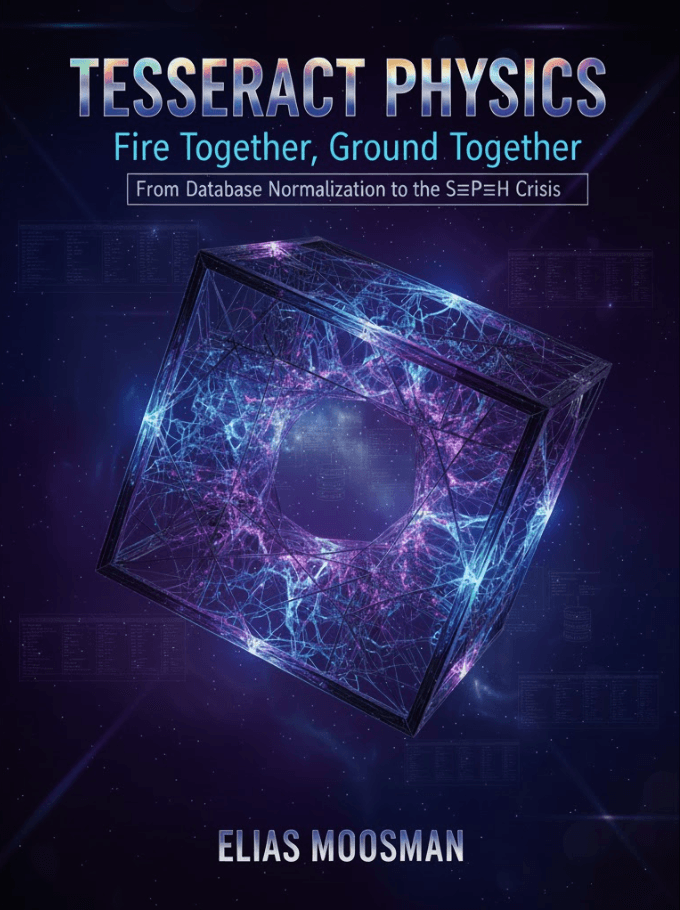
npx thetacog-mcp attest-demo and reply IN to any briefing. The measurement is open source (MIT) — we only license the financialization of it.Tesseract Physics:
Fire Together, Ground Together
From Database Normalization to the S≡P≡H Crisis
Your AI works. It still can't ship.
The first cars weren't held back by their engines — they were held back because nobody would underwrite them, so only the reckless drove. AI is in that year now. Whether a model's behavior will be “safe” is mathematically undecidable — Rice's theorem, not an opinion — and what can't be priced can't be signed off. So finished systems sit in pilots, not because the build failed, but because no one can bound them. The one thing that is provable — where the work landed — is what this measures, signed at the time and recomputable by the stranger who has to approve it.
Two people are stuck on this, and neither can move without the other: whoever wants to deploy — a CTO with a finished agent, a founder in a client's security review — and whoever holds the risk of approving it, the GC or CRO whose name goes on the line. Flag either. They get one surgical briefing; nothing starts until they click.
Read • Listen • Revise • Shape the Book
Sign in to join the Living Book: Read with AI voice, suggest revisions, and help converge the truth.
Contributing Editors (5+ revisions) get the book free when it launches.
No credit card required • We approve requests within 24-48 hours • 127+ beta readers active
A living book. Read, select text, suggest edits—the book evolves with reader feedback.
Browse every passage the club has sent: the Daily Book Club archive →
The quiet part — why a free book club talks like it has a balance sheet
The book club is free and it stays free — no catch, no upsell arriving in month three. But what we've built is now dimensioned for a good deal more than a book club, and this is the stretch where we're talking to the people who fund work like it: the accredited-investor kind, and the ones who know them. A recommendation or an introduction counts as much as a check.
The whole thing is open source. You can run it, read it, or take it apart on your own machine today, without asking permission or booking a demo. The full book text is bundled in the same repo — data/book/COMPLETE-BOOK.txt — so you can drop it into your own AI and ask it questions.
Why the balance-sheet register? The same physics as the book, one floor down. You cannot price an AI's liability from its own software logs — that is the undecidability the whole book is about — and a hardware-attested placement, the kind the tool computes locally, is the only artifact an underwriter can actually price against. Free to measure; paid to underwrite. That gap is the thing being built.
If you back infrastructure at this layer — or know the person who does — write to elias@thetadriven.com.
This is a note about where things stand — not an offer to sell, or a solicitation of an offer to buy, any security. Any investment would be offered only to verified accredited investors, and only through formal offering documents. Nothing here is investment advice.
What Does "Fire Together, Ground Together" Mean?
Fire Together, Ground Together is the central principle of Tesseract Physics. It explains why your database slows, your AI drifts, and your consciousness binds—not three separate problems, but one physics violation.
When systems fire together (associative activation, like neurons that fire together wire together) AND ground together (maintain semantic-physical alignment, symbols grounded in reality), they exhibit trust compounding and zero drift.
When they diverge—when S ≠ P—you get cache misses (databases), hallucinations (AI), or the hard problem of consciousness (biology). This is the Unity Principle (S≡P≡H): Semantic State ≡ Physical State ≡ Hardware State.
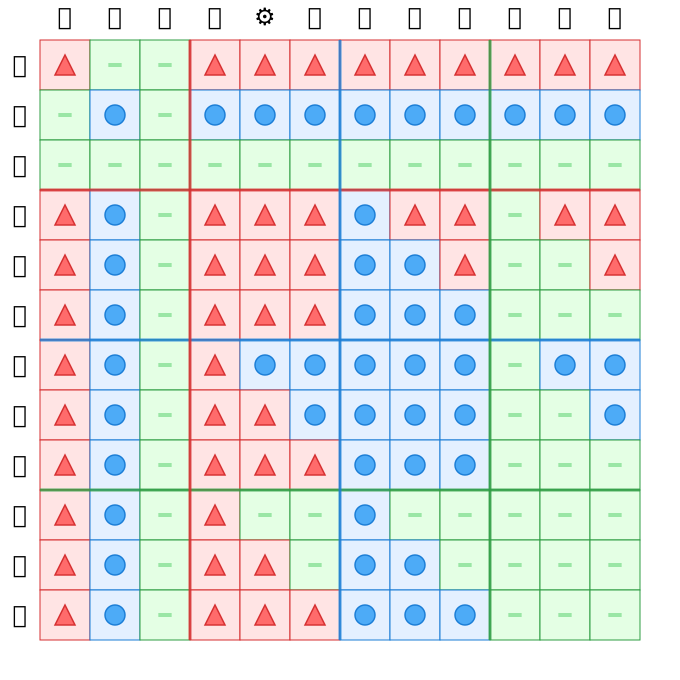
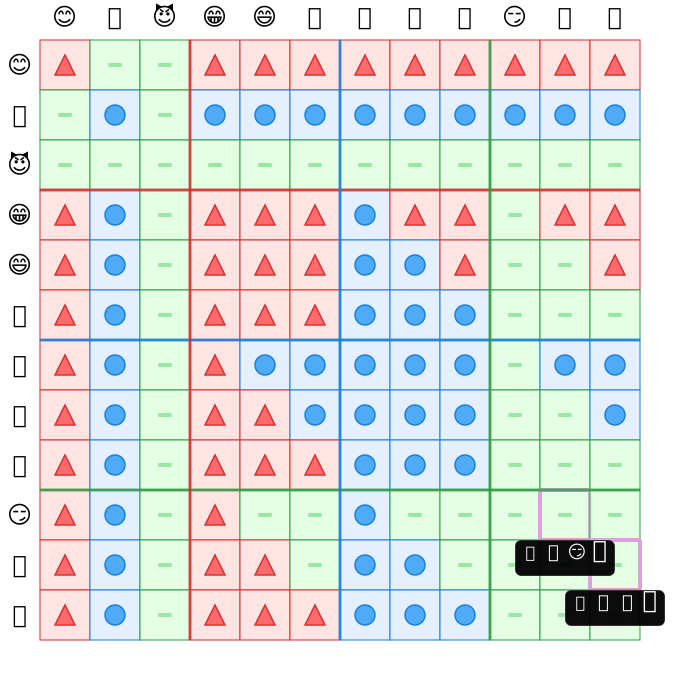
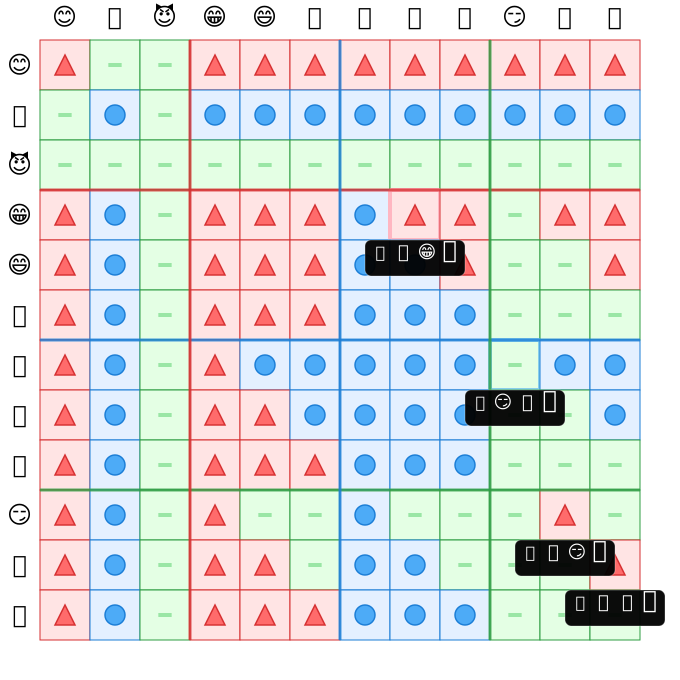
FIM Artifact Dynamics
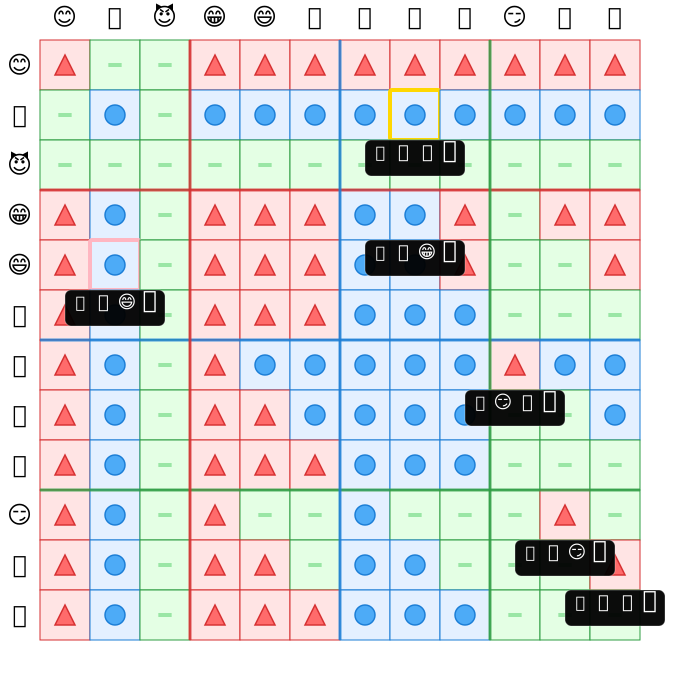
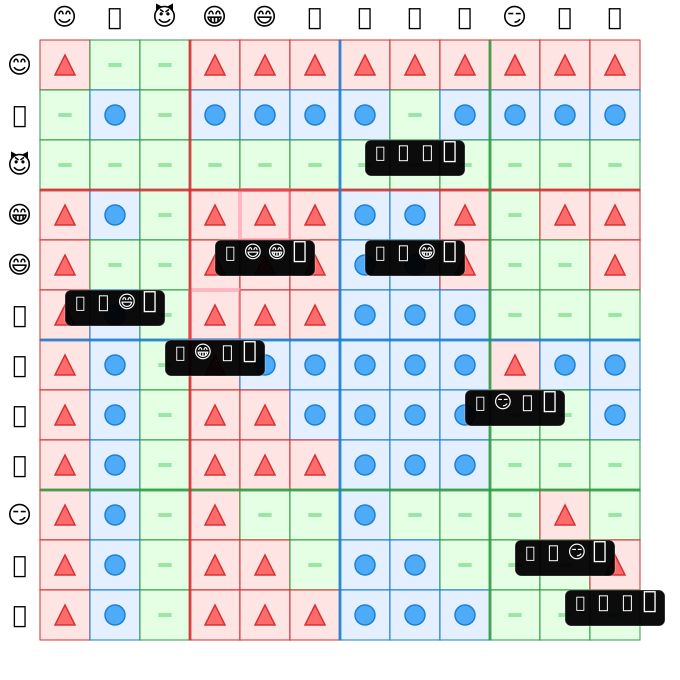
Watch 2 cells flip per frame (the "Gestalt unit" - 17 bits of intuition-level precision).
4 frames = 8 flips = 65.36 bits total ("age of universe" precision).
2^65.36 ≈ 49 quintillion states • Universe: 13.8B years ≈ 435 quadrillion seconds • Precision: ~100 measurements/second across entire universe timeline
This is how you learned to read faces—one "word" at a time.
The Book Is the Theory. IAM FIM Is the Implementation.
Finish reading the physics, then deploy it. Same 12×12 grid. Same S≡P≡H principle. Production-ready.
🎓 This Book Is Your Training Manual
40% of customers who have a bad AI experience never come back.
When your AI fails, can you promise it will do better next time?
Most people have hope, not math. You'll have physics.
Your database slows. Your AI drifts. Your goals fog.
Not three problems—one physics violation: S ≠ P
The unifying principle Database Heretics, AI Doomers, and Pattern-Seeking Investors have been searching for.
A paradigm shift in a book. Not content → Cognitive substrate.
Read the Full Book FREE
The entire book is FREE to read — just sign in to continue past the Preface.
No paywall. No tricks. Just knowledge that should be shared.
🎧 Listen to the Preface
Full TTS support • Sign in to unlock all chapters • Preface is open to everyone
If This Helps You See, Support the Work
Waste is suffering. If this framework helps you eliminate it, here's how to help:
Reviews compound discoverability. IAM FIM provides the right constraints for agentic workflows.
Physical artifacts ship when ready.
📖 Navigate the Metavector
Why This Exists
When semantic equals physical equals hardware, reality converges. When they drift, trust debt compounds at 0.3% per decision.
This book teaches you to see convergence and drift in physical substrate—not as metaphor, but as measurable physics.
First of its kind: A living book that evolves with reader feedback. You don't just read—you help it converge to truth.
Does This Sound Familiar?
- ❓“My database gets slower over time, even with perfect indexes”
- ❓“My AI model drifts from training intent, but I can't measure when”
- ❓“Every system I build fails the same way, but I can't name why”
- ❓“I see patterns across domains (database, AI, goals) but lack the unifying equation”
- ❓“Cache misses and AI hallucinations feel eerily similar”
- ❓“Everything drifts over time—is there a physics law?”
They're all the same problem:
S ≠ P
(semantic does not equal physical)
Speaking Engagements
Interested in having Elias speak at your event, conference, or organization?
Topics Include:
- •Unity Principle (S≡P≡H) - Why semantic-physical alignment determines system performance and AI alignment
- •Existential stakes - EU AI Act enforcement (August 2, 2026), AGI timeline (2030-2050), and why normalization blocks alignment solutions
- •From cache misses to consciousness - How 0.3% drift operates at consciousness-collapse threshold without biological compensation
- •Practical implementation - CRM systems, granular permissions, and production patterns that preserve existing infrastructure
- •Cultural alignment - How measurement capability spreads through N² network effects and moral obligation to share the instrument
- •Living books and cognitive substrates - The future of knowledge transfer through embodied learning
How to Request:
- 1.Join the waitlist: If you haven't already, sign up here to create your account
- 2.Email us: Send your speaking request to elias@thetadriven.com
- 3.Include: Event details, audience size, topic preferences, and date/location
Serious inquiries with verified accounts are prioritized. Creating a waitlist account helps us filter spam and ensures faster response times.
💥What Happens When Pattern Recognizers Read This Book
The moment when the splinter in your mind finally has a name: S ≠ P
"HOLY SHIT - it's not the index, it's the SCATTER! Normalization forces randomness!"
"FINALLY - a measurable threshold! 0.3% trust debt per decision! Hardware performance counters don't lie!"
"This is it. S≡P≡H is the unifying equation I've been searching for across domains."
"Cache misses and AI hallucinations are THE SAME THING?! Both are S≠P violations! Mind blown."
"It's not entropy—it's S≠P! When semantic drifts from physical, trust debt compounds at 0.3%!"
"Position EQUALS meaning! Sorted structures ground semantics in hardware! THAT'S the physics!"
Ready to experience your own "aha moment"?
📐 Technical Appendices
Unity Principle Formal Derivation
Mathematical proof of S≡P≡H from first principles
Cache Miss Cascade Proof
Physical overhead of semantic-physical decoupling
FIM Patent Details
Focused Information Metric patent documentation
QCH Formal Model
Quantum Coordination Hypothesis mathematics
Trust Debt Formula Derivation
Mathematical formulation of alignment drift costs
Precision Degradation Mathematics
Information loss in ungrounded systems
Brain-Computer Interface Predictions
For Professor Lima: BCI and falsifiable predictions
Constants from First Principles
Deriving k_E, M, Φ from physics and neuroscience
Resonance Threshold Derivation
Critical threshold mathematics for coherence collapse
Permission Mathematics
Formal mathematics of agency and control theory
Temporal Hierarchy
Time-domain analysis of Unity Principle dynamics
The Mirror of Exponentiation
Why (c/t)^n and (c/t)^N produce opposite physics — the Tesseract Maneuver and time-as-entropy
🗺️ Meta-Maps & Navigation
Metavector Transpose Navigation
How position creates meaning through matrix jumps
ShortRank Progression Map
Complete metavector flow tracker
Tesseract Flow Protocol
9-dimensional navigation system
Alignment Backbone
S≡P≡H unity architecture
Book Tesseract Map
Complete chapter navigation
✏️ Recent Edits
Keylock Fit Integration — March 28, 2026
10,000+ words of new prose across 8 chapters. The Arkenstone/Ring architecture, Vinge's Zones of Thought, the Progressive dongle, Gibson's consensual hallucination, Simmons's Hyperion Allthing, and the growth path: Submit, Recalibrate, Release.
Keylock Fit — Drift Decomposition
ShortLex breadth-first decomposition of the Keylock Fit: 4 latent factors, 12 focused members, 36 terminal nodes. The quantum of influence when it is legitimate.
🏛️ Analysis Reports
The Judo Flip
A Proleptic Writing Device
Prolepsis: The rhetorical technique of anticipating and voicing reader thoughts before they fully form them.
This book uses a specific variant called The Judo Flip—where your objection becomes evidence FOR the thesis, not just validated and dismissed.
Pattern:
- 1. INTERRUPT — Break reading flow. "Stop." "Pause."
- 2. VALIDATE — Voice their thought. "You're right about X."
- 3. FLIP — Your objection IS the proof. "That skepticism IS the evidence."
Example from Preface:
"Your bullshit detector just activated... The Judo Flip: The fact that the number feels unreal IS the evidence."
Example from Chapter 4:
"Something IS resisting... The Judo Flip: That resistance IS the system working correctly."
Deep-link catalog • Jump to exact locations in chapters • Study the technique
New to the title? What “Fire Together, Ground Together” actually means →
✎ How to Shape This Book
As you read, your neurons will fire together on certain passages—and misfire on others. That's the signal we need. Help us align the book to what resonates with insiders like you.
- 1.
Read and Feel
Navigate chapters. Notice where the substrate catches—and where it doesn't.
- 2.
Select Text
Highlight any passage that needs clarity, correction, or deeper exploration.
- 3.
Select Text or Hit Floating Button
Select the text you want to comment on, then click the purple revision button (bottom-right) to open the feedback panel. The panel opens automatically when you select text.
- 4.
Suggest & Submit
Paste your edited version or add a comment. We'll integrate insights that strengthen alignment.
🤝This is collaborative truth-seeking. Your feedback makes the metavector sharper for everyone.
✨ Invite Other Editors
Know someone who would catch logical gaps or strengthen the argument? Invite them to read as an editor.
Defensive Patent Filing: This manuscript is part of defensive prior art for the Unity Principle methodology. We need ~10 sharp beta readers to help bind together what insiders already believe but struggle to articulate. Your invited editors strengthen the record.
🏆 Sponsor Edition - $97
The book is FREE. This is for those who want to support the research and get extra recognition.
Sponsor benefits:
- ✓Listed as “Sponsor” in the book acknowledgments
- ✓EPUB download + all future updates
- ✓Direct support for Unity Principle research
- ✓Priority response on feedback and revisions
🏆 Contributing Editors
Make 5+ applied revisions → Listed as “Contributing Editor” with specific insights credited (free tier)
Support the research • Get recognized • Shape the future of grounded systems
Ready to Implement the Physics?
You've read the theory. Now deploy it.
IAM FIM takes everything in this book—the 12×12 grid, S≡P≡H, position-based verification—and makes it production-ready.
When your AI agents need grounded permissions, not probabilistic policies.
What IAM FIM provides:
- ✓Grounded permissions — Path exists or it doesn't. No policy drift.
- ✓Agentic workflow constraints — When AI acts autonomously, verification is physics.
- ✓Audit trail by default — Transpose walks are mathematically verifiable.
- ✓EU AI Act ready — Explainability built into the substrate.
🎯Who This Is For
CIOs and CTOs deploying agentic AI at scale
Security architects who know policy drift is the real breach vector
Platform teams building guardrails for autonomous systems
Anyone responsible for AI governance before regulators make it mandatory
$1,995/seat • Enterprise licensing available • Share with your CTO, CISO, or board
Just want to help? Leave an Amazon review — it's the easiest way.