The difference between what a system says it is doing and what it is doing has weight. That gap is where every AI failure and every uninsurable liability lives, and the gap can be measured, so it can be priced. Read the other way, the same measurement is personal: you are not about to be averaged out by a generalist.
Next time you wonder how to help, tap the sticker. The sticker carries the word to the next signer.
A word from a peer gets read. The same word from a vendor gets filed.
▶ Hear the case in four minutes (3:50) → Take 83, recorded on my phone. Rooms that want the talk book it at thetadriven.com/speaker.
I was offered a few minutes at the Royal Institution on 10 November, in the Faraday Lecture Theatre, and I am grateful for it: recognition is exactly what this work needs right now. One evening does not carry a transatlantic flight, so my seat is pending. If you know a room in London that week that would hear the talk, forward this email to whoever runs it. One more room and I am on the plane.
The market agrees. From January 1, 2026, the standard liability forms let insurers exclude generative AI outright (ISO CG 40 47, CG 40 48, CG 35 08). Insurers won't carry what they can't count. We sell the count.
No highways before insurance: uninsured roads never get built, and the cars never improve.
If you sign for an agent: Whether it was good is undecidable (Rice, 1953). What it actually did cannot be reconstructed from its own account (the data processing inequality). The only remaining move is to read a record the actor did not write.
You would be forgiven for calling an answer to that impossible. What we did, and how it holds, follow the book.
Ask the insurance industry why they will not insure AI.
Jump as high as you can; nobody jumps off sand. An AI budget is that jump, standing on sand: the deployer cannot fund a rollout nobody can price, and the underwriter cannot price what nobody measured, so the same deal stalls on both desks. The sovereign asks whether: a licence, a pause. The market asks what: where the work landed against what was declared, written down as a receipt anyone can check. Only that can be priced.
Your strongest engineer will defend your AI this week by calling it deterministic, to reassure the room. The word will work, and everyone will move on.
“Our systems are deterministic.”
They are. Completely. Pin the weights, the seed, the sampler and the batch — the same output, every run. Every step obeys; where the steps end up is undecidable (Rice, 1953). Determinism is undecidable chaos. Determinism belongs to the replay. Autonomy is the part where nobody fixed the input. You can replay yesterday. Nobody has ever replayed tomorrow.
An agent’s loss lands on the company. Whether oversight was even possible lands on you (EU AI Act, Article 14).
Today’s chapter is the same mistake, made by a whole field for sixty years.
Grip
There is a word for this that every person who has ever been responsible for anything already owns, and it took me the better part of twenty years to think of using it.
Grip.
Ask anyone who has run a team, a shift, a ward, a kitchen, a boat. Not one of them will ask what you mean. Nobody needs a definition, because to them the word is not describing a concept, it is describing a Tuesday. You never have the time. You never have the mental room. You never have the money, or the people, or --- the one nobody says out loud --- the emotional resourcefulness to do the thing you can already see needs doing. It runs through your fingers. You end the day having handled what arrived instead of what mattered, and you know the difference, and knowing the difference is the part that costs.
That is not a failure of character. It is the same measurement this chapter has been making, taken from the other side. The exhaustion in the conference room is your body objecting to a gap it is being asked to hold open inside one skull. Grip is that same objection when the gap is not inside your head at all --- when it is the distance between you and the thing you will be answerable for. You cannot close that one by concentrating harder. That is what makes it different, and it is why it wears people out for decades without ever resolving.
And here is the part I could not see until recently, because for the whole of human history it did not need seeing.
You have always survived losing grip. Not because you were good at it. You survived because the systems you were losing grip on were made of people, and people come with slack. The junior told to do something stupid hesitates. The colleague who could technically follow an instruction all the way to its literal end does not, because the literal end is obviously insane and they have a mortgage and a capacity for embarrassment. Culture, hesitation, the pause before the message goes out, the quiet decision not to be the person who did that --- these are not soft skills. They are shock absorbers. Every organisation you have ever worked inside was running on them, none of them appear on the org chart, and they are the reason a lapse in your attention costs you a quarter instead of the company.
Now take the slack out and keep the velocity.
That is the whole of what an autonomous agent is. An agent does not hesitate, because hesitation is a metabolic event and it has no metabolism. It cannot find an instruction embarrassing. It has no mortgage. The agent will carry a reasonable-sounding directive past the point where anyone in the building would have stopped and asked. And it will do that at machine speed, a great many times over, before the ache in your chest has finished forming. The gap you can feel arrives after. Your early warning system was calibrated against a substrate that came with brakes.
So the question stops being whether you trust it. Trust was never the mechanism. Slack was the mechanism, and trust was the word we used for not having to check. Take the slack away and the word has nothing underneath it. What is left is whether you can get a grip.
I want to be careful with that word, because I do not mean control.
There is a paving stone in Mexico City I walked past in the rain and have not stopped thinking about. It runs along Paseo de la Reforma: raised bars underfoot, a tactile strip set into the concrete, and beside it a bronze map with a raised dot that says usted está aquí. Traffic going past at speed, and a person who cannot see is expected to cross it.
Nobody solved that by writing better guidelines. Nobody handed anyone a probabilistic assurance that drivers would try their best. Somebody bolted a physical boundary into the ground at ankle height, where a foot finds it without asking permission from anything. The strip does not steer. It will not stop you walking off it. It tells you, continuously and without argument, whether you are still on the path --- and that one bounded fact is what makes the crossing survivable instead of brave.
That is grip. Not the power to prevent the step. The ability to know, at the moment it happens rather than at the inquest, that the step went somewhere it was not supposed to go.
Which is why the ordinary version of this carries more weight than it looks like it does. If you employ a plumber and he starts running conduit, you may not need to stop him. Perhaps the job genuinely required it. The plumber might have been right. What you cannot afford is to learn afterwards that he did it, that it was visible the whole time, and that nobody in your building had any way to notice. The failure that ends you is not the plumber. What ends you is the sentence we had no way of knowing, said under oath, by you, about a system you chose to deploy.
Sit with that sentence for a moment. Almost everything else in this book is an attempt to make it impossible to have to say.
“I am the one holding the bag when our AI breaks a client contract. Every change our agents make now carries a receipt the machine did not write, one my carrier can recompute.”
— ______________________________
Would you put your name on this? Would your boss? Would anyone you know?
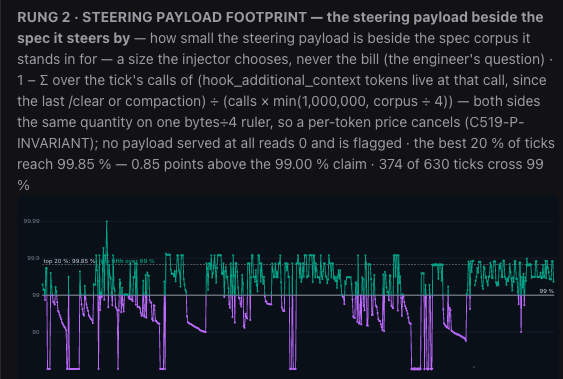
An agent’s log is words about words, the loop Stevan Harnad named in 1990. Each word points to more words; the chain branches without end and never reaches ground. The field took that runaway as fate. A runaway is only fatal in an open space. Close the space, so every word has a place and nothing is left outside, and the same branching turns into confirmation: many independent paths agreeing on one place. A nerve cell decides the same way inside its membrane: one input proves nothing, and many independent inputs, summed, carry the call. We have been closing that space since the summer of 2000. How the floor is built, and the one condition it rests on, follow further down.
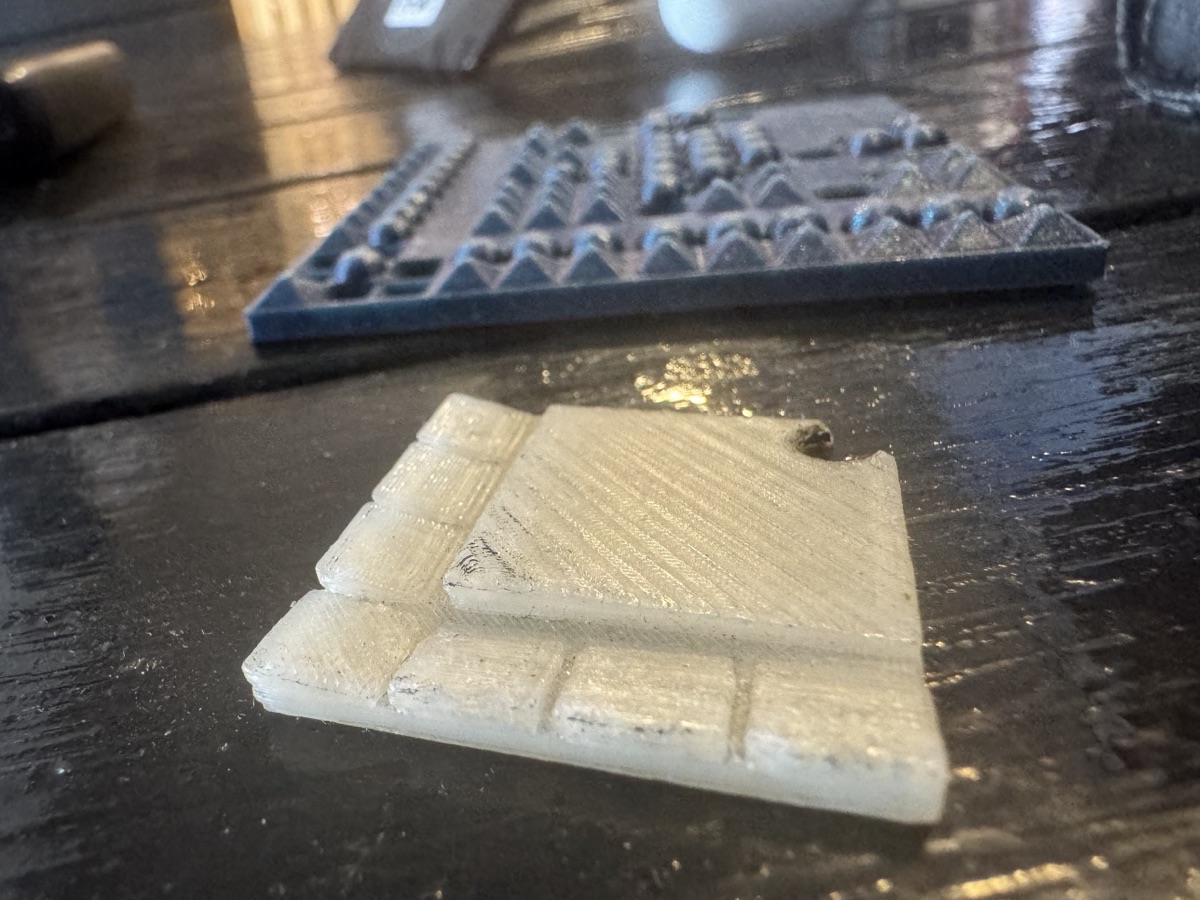
Further down: a photograph of the physical piece and the checks you can run yourself.
A word you never declared has no address, and the receipt says so instead of guessing.
Two ways to prove us wrong, both public: find a definition on the floor that does not stop, or a change written in your own specification's terms that lands outside its lane. Measured: the walk returns the same bytes on a Mac and on Linux, Intel and Arm alike, in an open cross-architecture check anyone can rerun (IntentGuard, tests/cross_arch.rs).
The mathematical proof and the empirical runs follow further down.
We detect, place, price and dispatch. You hold the wheel: the halt is yours to wire. iamfim.com

They were being precise. Not loose. Precise.
Now read their own sentence back and notice what it says. The sentence says the machine repeats itself. The sentence does not say the machine does what you asked. Anyone who has written a line of code has watched a deterministic program crash, loop forever, corrupt the table and halt on the wrong branch — identically, every run, exactly as designed and nothing like intended. Determinism has never once meant a system is under control. Determinism means the system does the exact same thing twice, given the exact same input. Change that input by the width of a butterfly’s wing and a deterministic system can end somewhere else entirely: Lorenz showed it in 1963 with a weather model that was fully deterministic and, past a horizon, unpredictable in principle. Deterministic chaos is still determinism.
And there is a smaller sentence hiding inside the big one: a deterministic autonomous agent. Its input is the morning — an inbox that moved, a file rewritten under it, a tool that answered differently than it did on Tuesday.
When you hear those two words in the same breath, pay attention. Those two words are the most reliable tell in the room that somebody has been asked for a guarantee nobody can give and has reached for the nearest word that sounds like one. The speaker is usually the strongest engineer in the building, which is precisely why the sentence goes unchallenged.
The computing sense is the version you can prove with your logs. The English sense — predictable, under control, will do what we intended — is the version the audit committee and your regulator are reading out of those same logs.
The long form: The two determinisms · the river is the prompt. Determinism reassures a room rather than confusing it — and that is what makes it the expensive word.
You just read where the eviction is held: in the slot, at the clock of the write. Your logs were written afterwards, by the thing they are about. That is where the law starts.
Am I personally liable for what my agents did?
The financial loss lands on the company. The question of whether effective oversight was even possible lands on you.
That phrase — effective human oversight — is the one the EU AI Act turns on (Article 14). The Act lists what the overseer must be able to do; it draws no line for when that bar is met. The line will be drawn the way every such line is drawn: by the first people who have to argue about one. There are two roads out and no third.
If effective oversight was possible and you did not have it, that is the easy case. Your insurer declines for negligence.
If effective oversight was impossible — if nothing you owned could have told you where that agent went — then you were never in a position to be responsible for it. And an owner who cannot be responsible is not given command of an asset. The liability has your name on it.
You are the captain. The crew is autonomous. No underwriter in three hundred years has asked a captain for a better crew. Underwriters ask for the logbook — the record the crew does not get to write after the fact.
The sentence to hand your risk officer: “An agent incident is any action outside the lane declared before the run, counted from a record the agent did not write.”
The measurement is free. The sealed logbook costs $20 a year per agent. Seal it, or hold the liability unrecorded. Buy the stamp →
You already have a control environment, and it is not a bad one. The prompts are versioned. The models are pinned. The eval suite runs in CI and goes red when it should. Every action the agent takes is written down with a timestamp and retained for seven years. Ask the industry what more you could possibly do and you get a longer version of that same list.
There is one property that list does not have, and doing the list better will never add it. Every record on it was produced by the process it describes. The agent reports its own actions. The eval was written by the team that wrote the thing it grades. An account of a run, produced by that run, cannot contain what the run never noticed — and that is not a claim about anybody’s honesty. The claim is about where the account came from.
Which is an old problem with an old answer. Double-entry bookkeeping (1494) never asked a merchant to be honest — it made the books check themselves, every debit against a credit. The audit that grew up around it added the part that matters here: a second hand that did not write the first entry. That requirement is why a stranger will lend you money. Your AI keeps one book. So does everyone’s.
The industry’s answer is to build better first entries: more evals, more guardrails, another model watching the first one — each of them written from inside the same boundary as the thing it watches. We went the other way and put the instrument on the far side of it, so the record is one the agent did not author. That is the entire difference, and it is why the claims that follow sound outlandish coming from a small shop. The gap is not cleverness. The gap is where the instrument stands.
And if it is wrong, it is wrong in one specific place, so here is the sentence to swing at. Name one record in your stack that was not produced by the thing it is about. Reply with it and you have taken this apart in public — and we will publish that you did.
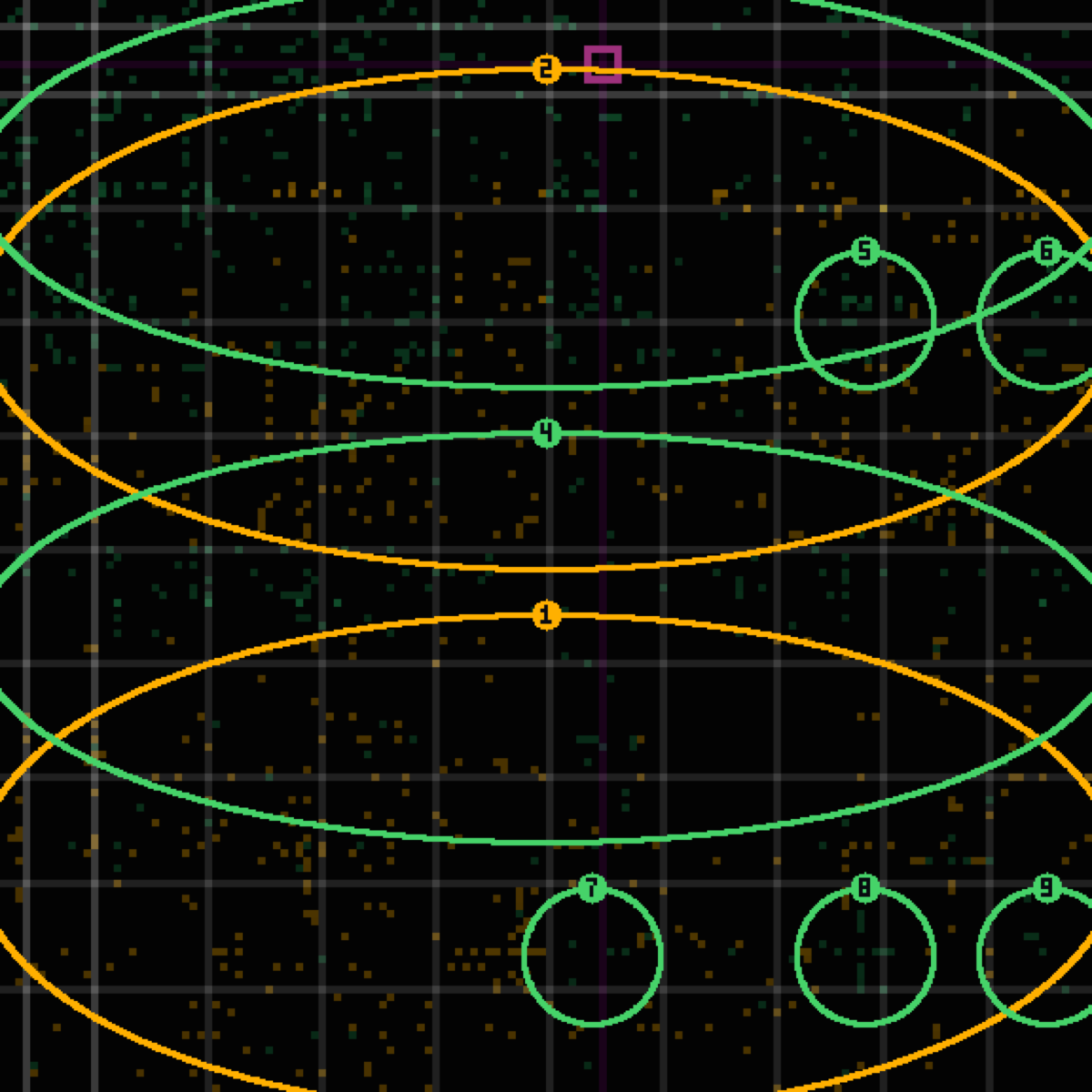
Every square on the grid is a crossing: one row meeting one column. The walk starts at the square your declaration names and runs along its row to the eleven squares that share it, then turns down each of their columns, then along those squares' rows again — row, column, row, column — each step counting for less than the one before, so near squares glow and far ones fade. Run it on what you declared and you get the first picture. Run it on the code that shipped and you get the second. Same arithmetic, same bytes, the same picture every time you rerun it. Each commit's panel is kept with a signed row on the walk tape naming the commit, the hash of the text walked, and the hash of the exact binary that walked it — so the picture can be redrawn and compared, byte for byte. That is how the walk stops the dictionary problem — every word defined by more words — in practice: a meaning ends at an address on the grid, not at another word. Where the two clouds disagree is the red in the commit panel further down. The walk is open source, MIT, and runs on your own machine: github.com/wiber/thetacog-mcp — the README carries all six panels.
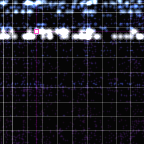 The walk on what you declared |
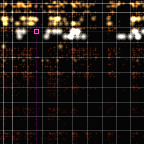 The walk on the code that shipped |

— Elias Moosman
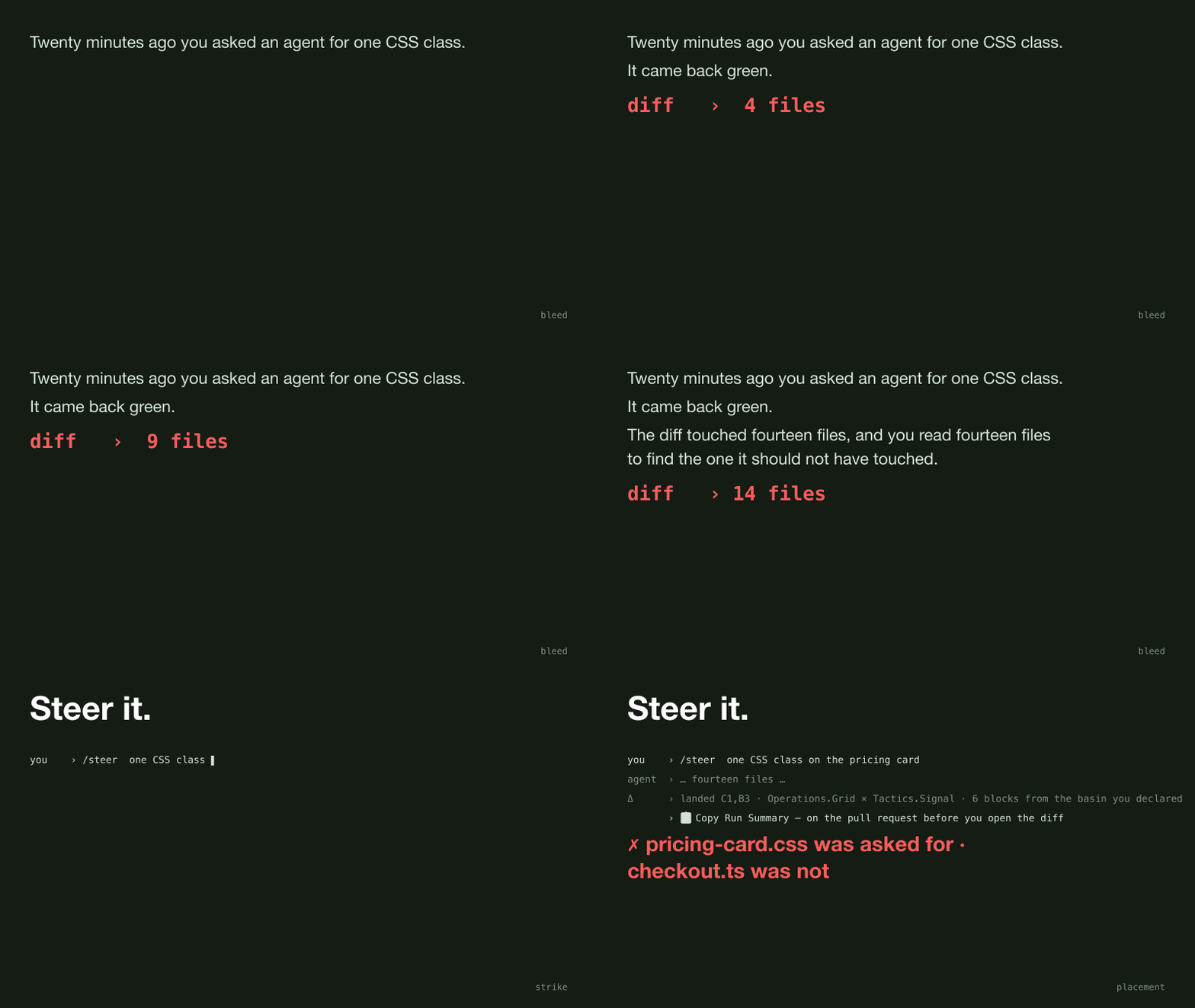


The install and the measurement are free and open-source (MIT); only the financialization/attestation layer is licensed. What a licence buys: the right to run the receipt on an agent in production under US Patent Application 19/637,714. One licence per agent, $20, good for 365 days or 10,000 countersigned receipts, whichever comes first. Each receipt records where that agent's work landed against what it was asked to do, and anyone can recompute it.
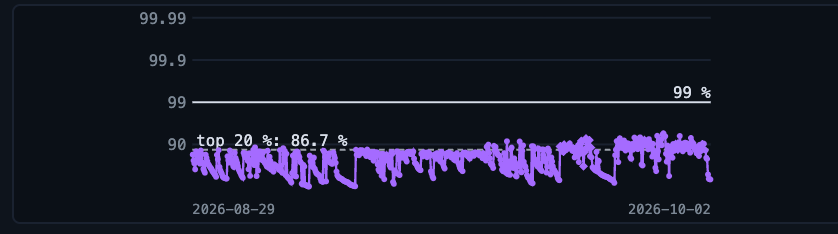
Insurance never prevented a single fire; it made fire a number. Your logs already say something happened — what they do not say is whether it was allowed.
And here is today's receipt — the one behind the actual work that shipped in this repo today, not a mockup: feat(blog): the bill post, round 3 — the two symmetries: if the meter is real the unit is real (k_E is what the meter reads in, its value measured never asserted), and if the trillion is reasonable the tape is reasonable (the condition under which the first bet is bookable) (2026-09-15). GREEN is in lane. AMBER is the bleed, one square out. RED is out of lane, and the circles mark where it clustered. The lane is a line somebody declared before the run; the placement is what the walk measured; the colour is only the two meeting. You do not have to read the math. You have to notice that the square where it left its lane has an address, and an address is countable — a count is the frequency half of a price, and the lane you declared is the severity half.
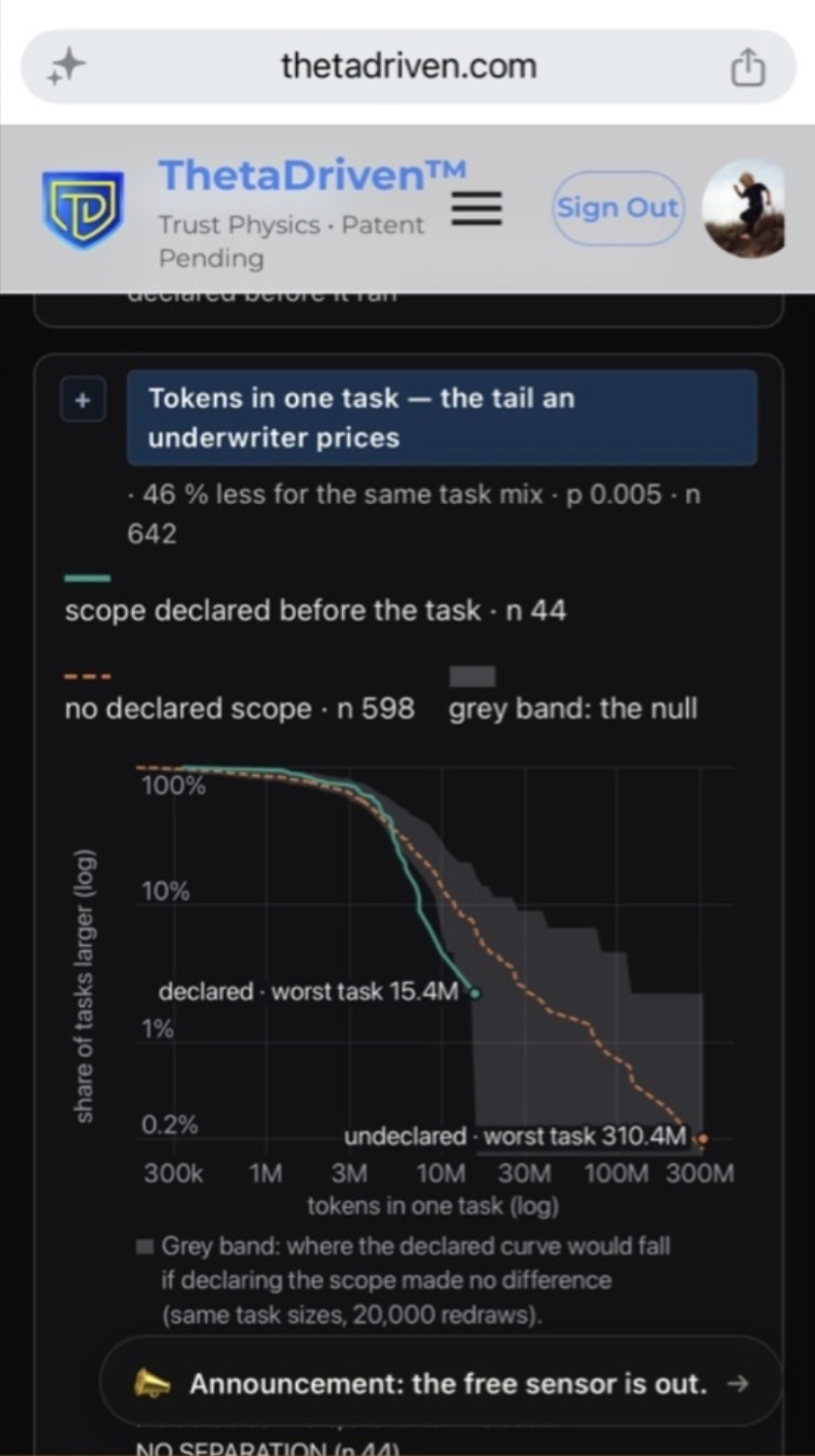
Open this commit's attestation — verify it yourself →
Rice’s theorem says nobody can prove your agent is good. We have never claimed to. We made where it went countable instead — and there are two doors on the next page, only one of them yours.
Yes. A decidable, still-semantic spec boundary for every autonomous deterministic AI agent.
And because this is the business of AI: buy at iamfim.com, and sleep like a baby. A baby sleeps because someone else keeps the night watch. Here the watch is a record your agent did not write: the lane is set before the run, the landing is checked after it, and your underwriter reads the record instead of your word. For the discerning sceptic — fork github.com/wiber/thetacog-mcp, run it on your last ten commits, and see what your agents touched in far fewer than twenty-one questions.
What does this mean for me? →Markets do not underwrite safety. Markets underwrite what a stranger can check. The count is live.
The question began in a conversation in the summer of 2000; the algorithm followed in 2007 and 2008.
Why a branching chain settles here instead of running away. In an open dictionary every word points to more words and the chain never ends. On the floor every word has a place and the walk only steps forward, so every walk ends: the matrix it runs on is nilpotent. The branching stays. Each place has twenty-two neighbours, and the floor branches far above one. As commits accrue, more and more paths confirm each landing: a cascade past its threshold, the dichotomy Galton and Watson proved for family names. A cascade proves something only if the paths are independent; a million copies of one path confirm one thing once. Inside each block of the floor, children are ranked by their parent’s rule. Where that rule is independent of the neighbours’ (correlation under a tenth), the ranking is a new axis. The book calls that part the resonator. A nerve cell does the same inside its membrane: weak, independent inputs, summed, carry a decision no single input could. Independence is the condition, and the book puts it under test in public rather than assuming it.
On this repository: the latest 150 of 29,694 commits, walked twice on one machine, rerun distance 0. None of the 150 is long enough for the walk to admit, so whether meaning moves a placement is still unmeasured, and we say so here.

|
The whole argument, on a disc that fits on a laptop lid. The disc is going to print.
|

We published three of our own bugs and left them open. Fork one, fix it — that is the
entire application. No CV.
|

ThetaCog Steer — VS Code ⇧⌘X, search "ThetaCog Steer" (id thetadriven.thetacog-mcp, free)
One thing it does: a worker boots from the spec row instead of the chat, and the commit gets a second entry the agent did not write.
https://marketplace.visualstudio.com/items?itemName=thetadriven.thetacog-mcp
|
Do you worry about $1.2B in AI liability? If the property is trivial, software can check it — and why are you paying to check trivial properties? If it isn’t trivial, Rice’s theorem says nobody can. So we fixed the math.
The one thing that actually helps: hit reply. A reply is the only
move a mail provider counts as a human being — it is what puts the next one in your inbox
instead of a tab. Type anything: a correction, an idea, one word.
|
thetadriven.com/book
ThetaDriven · Elias Moosman · elias@thetadriven.com