The human-mediated symbol grounding problem — and why every AI-safety proof has a footnote written in invisible ink.
This is not a complaint about engineering quality. The people doing formal verification and mechanistic interpretability are doing real, hard mathematics. The problem is deeper than effort can fix, because it lives where the math ends and the world begins — and at that boundary, today, there is nothing but a human brain, quietly doing the one job no one admitted they outsourced.
See the runnable proof → Jump to the mandate ↓Before the math, the story — because you already know this story by heart, and it has been saying the analysis out loud the whole time.
Every adventure worth telling has a magic object in it, and it is never the sword. The sword is the noise. The magic object is the thing that finally makes the hero's will land where the hero pointed it — the ring that fits, the compass that does not lie, the wand that turns intention into event with nothing lost in the gap. That is what the story is always secretly about: not power, but the closing of the distance between what you meant and what happened. The hero is not the strongest person in the story. The hero is the one whose intent survives contact with the world.
For three years the machine has handed us the opposite of a magic wand. It arrived dressed as one — an intelligence that could write the essay, pass the exam, hold the whole library in its head — and then it lost the plot. It invented a policy no one wrote. It did the brilliant thing and the ruinous thing in the same breath and could not tell you which was which. The industry romanticizes this as the frontier — the Wild West, “emergent behavior,” two hundred miles an hour on a dirt road and proud of the dust. Strip the romance and it is only this: the world not being as it should be. Losing grip is not a trial the hero passes through on the way to the thing. Losing grip is the failure of the thing — quiet, at speed, while everyone is still calling it progress. It is the chapter you wish were shorter.
And you do not get out of that chapter by summoning a bigger dragon. You get out by finding the artifact.
— Tesseract Physics · “The Chapter You Would Cut”
Mastery is not the absence of motion. Mastery is a zero gap between the intent and the event while both are happening at speed. That is causal coherence — the wand, not a bigger dragon.
And it is not a mood. Causal coherence is the countable version of that gap — measured, signed, anchored in hardware — the stick in the ground for autonomous work. The rest of this page is the mechanism of the wand: why every current proof of control quietly borrows a human to hold the grip, and what it takes to put the grip in the silicon, where the speed is.
Formal verification and mechanistic interpretability are valid — inside a closed, Turing-complete, syntactic loop. They are software verifying software. They prove that a system's internal logic is consistent: that the symbols agree with the other symbols.
But a perfectly consistent system is a perfectly sealed room. You can prove every theorem you like about what is inside it and never once prove that the room has a window. Because these tools never leave the realm of information — never touch a substrate the physical world also touches — their compression distance to physical reality is, by construction, infinite. Distance needs a shared substrate; a symbol and a thing have none. So the number isn't large. It is undefined.
The hallucination at the root of the field: a proof of internal consistency, mistaken for a proof of correspondence with the world.
The hallucination survives as long as the system stays sealed. It dies the instant the system acts — the moment it actuates, deploys, or emits an intent that something physical must now honor.
At that boundary, ungrounded information meets reality, and because there is no geometric bridge between the software's symbols and the physical universe, the noise across the boundary is unbounded. The system can guarantee, with full formal rigor, that its syntactic intent is consistent. It can guarantee nothing about whether the physical result matches it.
"It passed every test in the lab" and "it did something catastrophic in the field" are not a contradiction. They are the expected behavior of a proof that stops at the window.
So why does any of it appear to work? Because a human is sitting at the boundary. A human reads the output and, in their own mind, bridges the infinite distance — grounding the symbol to reality with a lifetime of embodied experience. The engineer looks at the dashboard and says "this circuit is doing addition," and the grounding happens — in the engineer, not the machine. The machine produced symbols. The human supplied the world.
The alignment industry is, without admitting it, relying on the human brain as the Semantic–Physical–Hardware translator — the one device we know of that grounds symbols in reality, because it is itself physical and evolved against the world. The proof is real. The footnote is invisible. And the footnote is load-bearing.
Here the paradigm does not weaken. It collapses into effectively nothing — and it does so at exactly the moment it was built for: autonomy. Human-mediated grounding cannot scale, on two independent axes:
Speed. A human cannot ground symbols at six million operations a second. The bridge is a person, and a person reads at the speed of a person.
Complexity. A human cannot hold the geometric shape of twenty thousand nodes of intent interacting at once. The bridge has a working-memory ceiling, and the system blows past it.
The entire justification for autonomous AI is that it operates beyond human speed and complexity. But that is precisely the regime in which the human bridge breaks. The instant the machine outruns the observer, the infinite noise floods the channel, and the system becomes — in the same instant — ungrounded, uninterpretable, and unverified. An interpretability method that needs a human in the loop is not a property of an autonomous system. It is a description of a supervised one. The supervisor was the product.
We do not argue that formal verification and mechanistic interpretability are bad ideas. We argue something far more dangerous to the status quo: that they are unfinished, and dangerously incomplete, until they are grounded in hardware.
Compile the semantic vocabulary into a verifiable, decidable geometry on the chip, so that a symbol's meaning is its physical position, and drift from intent becomes a measurable, recomputable, signed physical event rather than a judgment a human renders from outside the failure domain. This is Semantic ≡ Physical ≡ Hardware unity. When the meaning, the program, and the silicon execution are the same located thing, the compression distance to reality is no longer infinite. It is finite, measured, and decidable — because now the symbol and the measurement share a substrate.
That is what the Fractal Identity Map and the on-chip ballistic walk do. The definer-of-definer regress that has no floor in language — to define a symbol you need another symbol; to check a checker you need another checker — gets a floor in physics: a walk on a finite, acyclic lattice that halts by construction, at six million walks a second. And the boundary is stated, not hidden: the chip decides where the work landed against the spec, reproducibly; it does not pretend to decide whether a human approves the outcome. Grounding is physical and decidable; worth remains a human judgment — but now a judgment made with a physical receipt instead of instead of one.
The others built the room. This is the floor. If interpretability is not physical, and meaning is not decidable at the hardware layer, no machine can be trusted to run without a human holding its hand — and the hand does not reach to six million a second.
There is an older question underneath all of this. Where is free will hiding? The determinist looks at the neurochemistry, sees that every state is caused by the one before it, and answers: nowhere. But he is reading the wrong mathematical property. He looked at determinism and assumed that because a system is caused, it is solved. It is not. A system can be entirely deterministic and still be mathematically undecidable.
Turing proved it. A perfectly deterministic machine cannot solve its own Halting Problem — it follows its rules flawlessly, and yet for certain inputs it can never decide whether it will finish or spiral forever. It is determined, and it is ungrounded. So how does an undecidable system ever reach a resolution? Turing answered that too, in 1939: an Oracle — a decider outside the deterministic logic that looks at the loop the system cannot close and supplies the answer. The machine computes; the Oracle decides.
Decidability implies a decider. Free will is a function of decidable systems — and without a decider, there is none.
So free will is not an uncaused spark floating in the ether. It is the physical capacity of the Actor–Patient locus to act as the Oracle: the thermodynamic act of the ballistic walk that takes an undecidable, drifting simulation and forces it to resolve into time-reality. The machine determines; the human decides. And it is the same boundary the chip already draws — the deterministic measurement is where the meaning moved; the decider is whether it is grounded. The chip is the determinism. The human is the decidability.
That replaces the moral framing entirely. You do not hold the locus because you are culpable. You hold it because computation requires it:
1 · The machine is deterministic, but undecidable. As autonomous velocity rises, semantic drift compounds per boundary crossing, and the machine cannot halt its own hallucinations.
2 · The human is the decider. The Actor–Patient locus runs the ballistic walk to resolve intent into reality.
3 · The Competence Pixel is the measurement. It maps exactly where a specific human has successfully acted as the decider — where they reached Semantic ≡ Physical ≡ Hardware unity.
The container is not a religion. It is the mathematical necessity of the Decider.
Knock one down, four stand. The first four are substance — grounding, measurement, pricing, liability. The fifth is the labor market they unlock, and it comes last.
You cannot insure a Turing-complete black box: its compression distance to physical reality is infinite. LLMs checking LLMs leave both the worker and the verifier floating in the same ungrounded syntax — the noise across the reality boundary is infinite, making the risk mathematically uninsurable.
We install a local Semantic–Physical–Hardware bridge (npx thetacog-mcp). By compiling a semantic vocabulary into a 144-coordinate physical map — the reef — we close the infinite gap and hand your actuaries a system where meaning is a physical coordinate. If an enterprise cannot map its AI supply chain to this grounded reality, its risk is unquantifiable, and should not be underwritten.
Insurers get destroyed when claims rely on subjective interpretation. If a policy triggers on whether an AI "acted maliciously" or "hallucinated," you are buying a lawsuit. We draw a permanent fence: the system measures where the semantic mass sits, reproducibly, at 600σ precision. It never measures whether a human agrees.
An agent contracted to execute a strategy document has its drift measured against the Strategy coordinate. A meaning-preserving paraphrase moves the position slightly; a domain-breaking error triggers a massive distance alert. Drift contained means the intent survived. Drift uncontained is a physical, decidable failure. You underwrite the boundary crossing, not the vibe.
Before Black-Scholes, options trading was a casino, because volatility lacked a bounding equation. Right now, autonomous AI is a casino. We deliver the pricing mechanism.
Normalized Compression Distance against the reef provides a deterministic, exit-0 receipt of semantic drift per boundary crossing. Because the measurement is decidable and hardware-verified, it can be priced.
Five variables price an option. Each maps to the physics of semantic drift — and every input below already exists, logged. We publish the inputs now; the closed-form derivation is calibration, not invention.
| Asset price | the agent output's current coordinate placement — its NCD measurement on the reef |
| Strike price | the agreed lane boundary — the maximum drift (e.g. 600σ) before the intent is considered broken |
| Volatility · σ | the historical variance of this agent inside this pixel, pulled from the Map of Maps |
| Time to expiry | task duration / compute cycles allotted |
| Risk-free rate | the baseline hallucination rate of ungrounded frontier models — the ambient noise of the industry |
Once the volatility of a pixel is known, fair pricing is mathematically trivial: a tight cluster of 600σ placements is cheap to insure; an ungrounded model is not. We do not write the options — we license the toll road that calculates the strike price.
In 1932, the courts ruled an entire industry liable for sinking barges because it ignored a newly available technology — the radio. The defense of "nobody else uses radios" failed. The recomputable receipt is the radio.
Once Munich Re or Coalition understands that a recomputable receipt of AI intent exists, the standard of care shifts permanently. The mandate writes itself: we will not underwrite autonomous enterprise workflows unless they stream a hardware-attested, decidable receipt of semantic drift. The reinsurers enforce adoption simply by refusing to insure the alternative. The sales force is the legal standard of care.
This is where the market becomes a labor market — and it comes last, because it stands on the four above. Every time a buyer and an agent transact, they lock in a spec and a reef; the work executes, the distance is computed, the receipt is published. You do not trust an agent by benchmark — you trust it because its historical ledger shows a dense cluster of 600σ precision directly inside its assigned coordinate.
This is the birth of infinite specialization. If an agent proven in "Database Architecture" starts drifting into "Frontend Canvas Rendering," the system flags the transaction as uninsurable — and forces the question that drives the whole ecosystem: why are you out of your pixel? Work stays in the lane, the lane is insured, the transaction executes flawlessly.
And the same primitive answers the question the futurists keep fumbling. When AI removes humans from the causal chain of survival, the fear is that meaning collapses — that a post-work species spirals without a "container" to hold it. But meaning has always come from exactly two acts: creating value, or protecting what must not be destroyed. Both require skin in the game, and the competence pixel is where that skin gets priced — so a post-work economy reattaches consequence instead of severing it. The container the optimists and the doomers both reach for — religion, UBI, "find your purpose" — was never a cage to hold a hazard. It is a coordinate that tells you where your judgment is load-bearing, recomputable by anyone, and paid for because the system cannot hold without it. We do not argue this from philosophy. We price it. Skin in the game is the container.
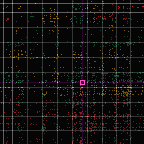
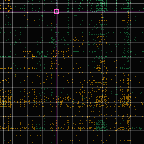
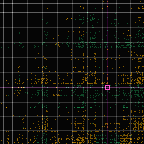
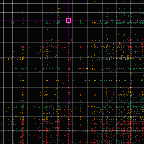
Green in-lane · amber a little out · red drift. Every panel below is a real commit that edited this manifesto, rendered by the instrument it describes — byte-identical if you recompute it. The argument proves itself, on itself.
Geometric Driven Development — 4 measured edits to this page. Recompute any of them: npx thetacog-mcp attest-demo
The argument above is not a thesis to believe. It is a measurement to reproduce. Install nothing — it runs straight from npm, and a stranger gets the same bytes you do.