
thetadriven.com/rooms/architect/benito-whisper
Benito at The Whisper Company
The Architect · rank 6 in this room
▦ your coordinate: A2,B3 (Strategy.Goal ⊕ Tactics.Signal)
Your inner monologue — written for you; correct it and it improves
Thirty years I taught mechatronics on one principle: intelligence you can't ground in a physical substrate is a seminar, not a system. I watched neural nets get rediscovered three times, and each wave forgot the same lesson — no observability, no control. Now this: a 144-cell address space where every action of an AI system lands as a measurable coordinate, drift as an XOR you can read off the substrate, running deterministic and sub-second on the chip. That's not another model — that's the observer the field skipped. The control theorist in me recognizes it instantly: you cannot regulate what you cannot measure, and someone finally built the sensor. I've founded three companies on smaller insights than this one.
Easy to agree with, easy to reject — either reaction is signal. If it misses you, say where it broke.
What I want out of this — said plainly, so you can price it
I want the control-theory kill you have been holding — observability, controllability, or the sensor model itself — because a flaw you can name in ten minutes is one I close this quarter instead of one a customer finds for me next year, and your kill is worth exactly what your yes is worth to me.
Why you're ranked here
You sit near the center of The Architect's cloud — the nine-room decomposition of what this work needs the world to understand. Rank 6 means: of everyone this room knows about, this belongs to you most. That is an honorific, not an algorithmic judgment of worth — and it's correctable by replying. Nothing here asks you to pass it to anyone.
You have a coordinate — A2,B3 (Strategy.Goal ⊕ Tactics.Signal)
Your coordinate is an occupation intersection: one room is where you'd actually be working, the other is the quality control on that work. That cell, A2,B3 (Strategy.Goal ⊕ Tactics.Signal), sits on the same 12×12 lattice every commit in this repo attests against — the same map that prices an AI agent's drift. Someone else may share your coordinate; what's yours alone is what lights up when you stand there — your confidence pixel — and that lighting is exactly what ranks the rooms below: your green spaces first, your red spaces where growth points. You didn't have to do anything to get placed. This is reverse market segmentation, not a judgment — and the direction you could grow in is readable straight off the map.
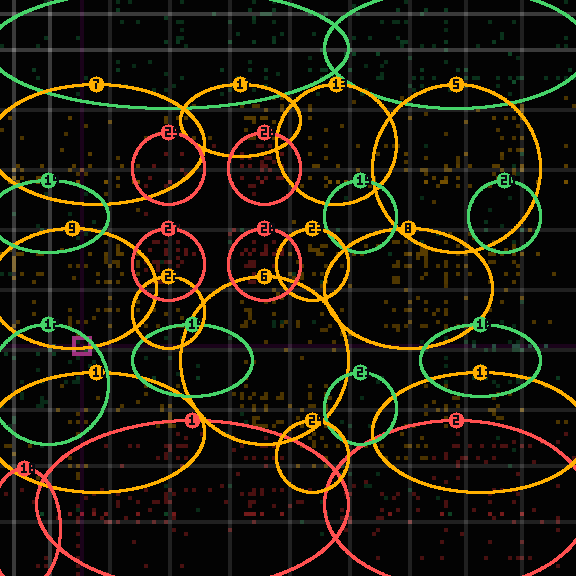
Don't like it? Change it — by intent or by action. Reply and say where you actually stand, or engage — run the demo, bind a room, send one objection — and the pixel moves with you. Either way, you own it from here.
What to look at, in this order — the short tour, picked for you
- A live commit receipt — INTENT · REALITY · Δ, off-lane circled
thetadriven.com/commit · 📐 architect
- The competence-pixel thesis — position equals meaning, at two altitudes
thetadriven.com/pixel · 📐 architect
- Run the receipt yourself — the on-chip walk demo, same verdict every run
thetadriven.com/pmu-simulator/demo · 🔨 builder
- Per-agent license pricing — $20/agent-year, documented
thetadriven.com/pricing · 🎭 performer
- The decidable-on-silicon claim we checked — attackable, with the command
thetadriven.com/blog/2026-07-04-decidable-on-silicon-the-claim-we-checked · 🎤 voice
Nothing here needs to be read in full. One link is a complete visit.
Your rooms — what lights up from your coordinate, green spaces first
1 📐 The Architect · 2 🔨 The Builder · 3 🧪 The Laboratory · 4 🎤 The Voice · 5 🎭 The Performer · 6 🧭 The Navigator · 7 🔒 The Vault · 8 🎩 The Operator · 9 ☕ The Network
The to-do list — if you wanted to do something
- 1.Run the on-chip walk demo — same lattice the commits attest against
- 2.Read the position-equals-meaning spine
- 3.Pick your room and bind it — 'I may know enough to work in this room' is the coupling event