
thetadriven.com/rooms/laboratory/david-lakera
David at Lakera (acquired by Check Point)
The Laboratory · rank 1 in this room
▦ your coordinate: A1,C3 (Strategy.Law ⊕ Operations.Flow)
Your inner monologue — written for you; correct it and it improves
Runtime security for AI is now a real category and it is inside a large security company, which changes what questions get asked of it. Enterprise security has a long habit that AI has not inherited yet: the log. Nobody argues about whether a firewall decision was wise; they pull the record of what was allowed and when, and the record is not a matter of opinion. Guardrails block, and blocking is the right primitive for attack. What the same buyer will want next — probably from the same vendor — is the boring artifact underneath: an un-editable, reproducible record of where the work actually went, so that a year later two parties who disagree can look at the same object and stop disagreeing about what happened.
Easy to agree with, easy to reject — either reaction is signal. If it misses you, say where it broke.
The whole idea, in four pieces — no jargon, nothing to memorize
You built runtime AI security and it now sits inside a security company, which is precisely why I am showing you this. Security buyers already budget for the artifact I am describing; they just do not have one for AI yet. Four pieces, about a minute.
1 · Guardrails produce blocks; audits need logs
Blocking is the right primitive against an attacker. It is not an evidentiary record, and enterprise security has always run on the second thing as much as the first.
Nobody argues about whether a firewall decision was wise — they pull the log. AI has not inherited that habit and the buyers you now sit next to will notice.
2 · A log line for where the work went
Not a score, not a verdict, not a block: an un-editable record of where a piece of work landed relative to what it declared, emitted at the time by the work itself.
It slots into a category your new colleagues already sell, budget for, and know how to retain — which is a distribution argument as much as a technical one.
3 · Two parties who disagree can stop disagreeing
A year later, both sides regenerate the same record independently and land on the same value. No vendor in the loop, nothing to take on trust.
The autonomous-flight years gave you a certification-grade evidence habit that most of this industry has never needed. This is that habit, applied to agent work.
4 · It makes no security claim at all
It does not detect attacks, does not block, does not assert an output was safe. Where the work landed, nothing more, with the limit stated in writing.
Which is what lets it sit beside a guardrail product instead of pretending to replace one.
If you can say where you are, how far in you are, and which way is bigger — you already hold the same model an architect holds. The rest is vocabulary.
Why you're ranked here
You sit near the center of The Laboratory's cloud — the nine-room decomposition of what this work needs the world to understand. Rank 1 means: of everyone this room knows about, this belongs to you most. That is an honorific, not an algorithmic judgment of worth — and it's correctable by replying. Nothing here asks you to pass it to anyone.
You have a coordinate — A1,C3 (Strategy.Law ⊕ Operations.Flow)
Your coordinate is an occupation intersection: one room is where you'd actually be working, the other is the quality control on that work. That cell, A1,C3 (Strategy.Law ⊕ Operations.Flow), sits on the same 12×12 lattice every commit in this repo attests against — the same map that prices an AI agent's drift. Someone else may share your coordinate; what's yours alone is what lights up when you stand there — your confidence pixel — and that lighting is exactly what ranks the rooms below: your green spaces first, your red spaces where growth points. You didn't have to do anything to get placed. This is reverse market segmentation, not a judgment — and the direction you could grow in is readable straight off the map.
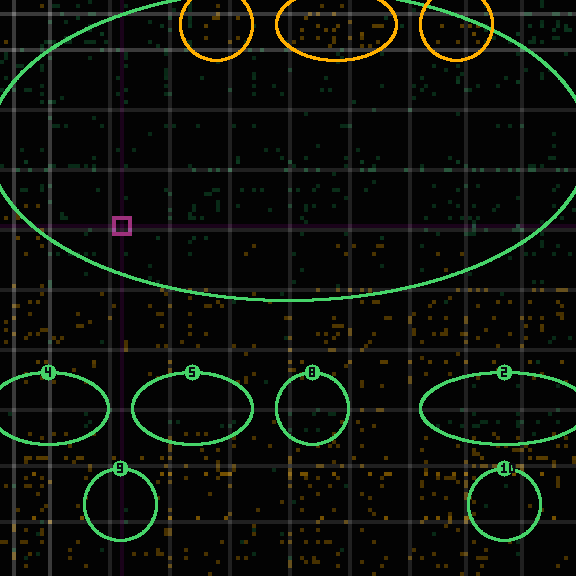
Don't like it? Change it — by intent or by action. Reply and say where you actually stand, or engage — run the demo, bind a room, send one objection — and the pixel moves with you. Either way, you own it from here.
What to look at, in this order — the short tour, picked for you
- One receipt, made by the work itself — thetadriven.com/commit
Open it twice. Byte-identical both times or the claim is false — that is the whole test, and you can run it without me.
thetadriven.com/commit · 🔨 builder
- The claim, written to be attacked
One sharp sentence, the command to check it, and an explicit list of what is deliberately NOT claimed. Read the not-claimed list first.
thetadriven.com/blog/2026-07-04-decidable-on-silicon-the-claim-we-checked · 🎤 voice
- The map — thetadriven.com/map
The whole argument at its top altitude, if you would rather see the shape than read the case for it.
thetadriven.com/map · 🧭 navigator
Nothing here needs to be read in full. One link is a complete visit.
Your rooms — what lights up from your coordinate, green spaces first
1 🧪 The Laboratory · 2 🔒 The Vault · 3 📐 The Architect · 4 🎭 The Performer · 5 🧭 The Navigator · 6 ☕ The Network · 7 🎤 The Voice · 8 🔨 The Builder · 9 🎩 The Operator
The to-do list — if you wanted to do something
- 1.Tell me whether 'log' is the noun a security buyer would actually use here, or whether there is a better one. You can hand me the right word in a sentence.
- 2.Open thetadriven.com/commit twice and check the readings are identical. That is the whole claim.
- 3.If the distribution instinct is wrong — if this is not something a security platform would ever carry — that is worth more to me than a meeting.