
thetadriven.com/rooms/network/big-kid
Big Kid
The Network · rank 49 in this room
▦ your coordinate: B1,A2 (Tactics.Speed ⊕ Strategy.Goal)
Your inner monologue — written for you; correct it and it improves
I'm at the point where nobody who matters knows me, and being vouched for by family counts for nothing — every room I walk into from here, I'm whatever I can demonstrate. So the idea landed differently than he probably expected. He's built a thing where the work files its own record of where it actually went versus where it said it would go, generated the same way every time, so a stranger who assumes you're exaggerating can go recompute it themselves. That's not a software problem to me. That's the exact problem I'm about to have for the next ten years. He solved it for machines first, which is funny, but the shape is the same: you stop needing to be trusted when the record is checkable.
Easy to agree with, easy to reject — either reaction is signal. If it misses you, say where it broke.
The whole idea, in four pieces — no jargon, nothing to memorize
Four pieces, then the consequence. The four are how the map works. The consequence is why it's worth money to strangers — and why it's the same problem you're about to spend a decade on.
1 · The zoom lens — scale is a choice, not a size
Any square opens into its own map with its own big and small. Nothing is inherently complex; it's complex until you choose an altitude to look from.
It's why the same structure can describe one afternoon's work and an entire career without changing shape. You'll use this on yourself more than on anything else.
2 · The vector — up buys context, down buys precision
Up the slope: more picture, less detail. Down the slope: less picture, exact detail. Every move spends one to buy the other.
It turns 'I don't know what to do' into a question with an answer: do I need more context or more precision right now? Almost every stuck moment is one of those two.
3 · The anchor — position before movement
You name the square you're standing on before choosing where to go. That's the anchor, and it's what makes you checkable.
This is the load-bearing one for you. Someone who can state their position can be verified; someone who can't has to be believed. Only one of those scales past the people who already like you.
4 · The crossing — the compass survives the border
Move into unfamiliar territory and the ground changes, but up is still general and down is still specific. The directions travel with you.
It's why you can enter a field where you know nobody and still orient in a week. New terrain, same compass — that's a portable advantage and almost nobody names it.
If you can say where you are, how far in you are, and which way is bigger — you already hold the same model an architect holds. The rest is vocabulary.
Why you're ranked here
You sit near the center of The Network's cloud — the nine-room decomposition of what this work needs the world to understand. Rank 49 means: of everyone this room knows about, this belongs to you most. That is an honorific, not an algorithmic judgment of worth — and it's correctable by replying. Nothing here asks you to pass it to anyone.
You have a coordinate — B1,A2 (Tactics.Speed ⊕ Strategy.Goal)
Your coordinate is an occupation intersection: one room is where you'd actually be working, the other is the quality control on that work. That cell, B1,A2 (Tactics.Speed ⊕ Strategy.Goal), sits on the same 12×12 lattice every commit in this repo attests against — the same map that prices an AI agent's drift. Someone else may share your coordinate; what's yours alone is what lights up when you stand there — your confidence pixel — and that lighting is exactly what ranks the rooms below: your green spaces first, your red spaces where growth points. You didn't have to do anything to get placed. This is reverse market segmentation, not a judgment — and the direction you could grow in is readable straight off the map.
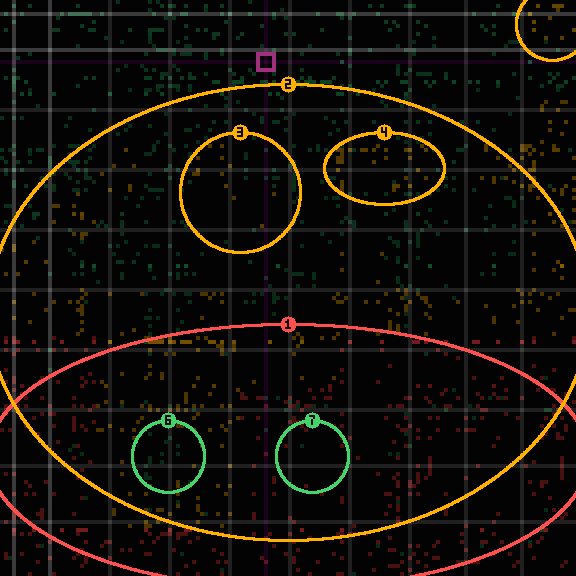
Don't like it? Change it — by intent or by action. Reply and say where you actually stand, or engage — run the demo, bind a room, send one objection — and the pixel moves with you. Either way, you own it from here.
What to look at, in this order — the short tour, picked for you
- A live receipt — thetadriven.com/commit
Open it twice, a day apart. Identical picture both times or the claim is false. That is the entire test and you don't need me present for it.
thetadriven.com/commit · 🔨 builder
- The nine rooms — the map at its top altitude
Nine big squares, each opening into its own map. It's the zoom lens as a thing you click rather than a thing I describe.
thetadriven.com/rooms · ☕ network
- The claim, written to be attacked — decidable on silicon
One sharp claim plus the command to check it yourself, and an explicit list of what is deliberately NOT claimed. Read the not-claimed part first.
thetadriven.com/blog/2026-07-04-decidable-on-silicon-the-claim-we-checked · 🎤 voice
- The competence pixel — position equals meaning
The grown-up version of the four pieces, including why being placed somewhere on a map is different from being scored.
thetadriven.com/pixel · 📐 architect
Nothing here needs to be read in full. One link is a complete visit.
Your rooms — what lights up from your coordinate, green spaces first
1 🧭 The Navigator · 2 🔨 The Builder · 3 📐 The Architect · 4 ☕ The Network · 5 🧪 The Laboratory · 6 🎤 The Voice · 7 🎩 The Operator · 8 🎭 The Performer · 9 🔒 The Vault
The to-do list — if you wanted to do something
- 1.Open one receipt at thetadriven.com/commit, then open the same one tomorrow. Identical or the claim is false. Ten seconds, no me involved — that's the point.
- 2.Find the sentence on this page you'd argue with. There is one. I would rather take the hit from you than from someone deciding whether to write a check.
- 3.Apply the anchor to yourself once: name where you actually are on something you're deciding, out loud, before deciding. It's a cheap experiment and it works.
- 4.If any of it lands, tell me WHICH sentence — not that it was good. The specific one is the only thing I can do anything with.