
thetadriven.com/rooms/operator/alexandra-jkj
Alexandra at Johnson, Kendall & Johnson
The Operator · rank 1 in this room
▦ your coordinate: A1,B2 (Strategy.Law ⊕ Tactics.Deal)
Your inner monologue — written for you; correct it and it improves
I told him I was confused about what he was offering, and I meant it plainly rather than as a brush-off. What arrived read like a software licence with a revenue split, and I do not resell software — I place risk. The two are not adjacent. My mandate is to find a carrier willing to put capacity behind an exposure my client already has, write it in language that survives a claims adjuster, and not be the broker who put his firm behind something that could not be defended afterward. AI exposure is the largest thing on my desk that I currently cannot place, and the reason is not appetite. Carriers will write almost anything if you can define the trigger. Nobody has handed me a trigger. Every submission I see wants to argue about whether the model behaved well, which is an argument, and arguments do not bind coverage.
Easy to agree with, easy to reject — either reaction is signal. If it misses you, say where it broke.
The whole idea, in four pieces — no jargon, nothing to memorize
You said you were confused by my last note. You were right, and it was my note that was wrong — I pitched you a software licence when the thing I actually have is a trigger. Four pieces, about a minute, and nothing you have to take on faith.
1 · The event is a boundary breach, not a bad answer
Every AI submission you have seen argues about whether the model behaved well. That is a judgment, and judgments get litigated. The event here is a measured line being crossed — a fact with a value attached, not an opinion about quality.
An adjuster can adjudicate a crossed line. Nobody can adjudicate 'the model was wrong', which is why the AI exposure on your desk has stayed unplaceable.
2 · Same shape as the parametric cover you already place
A parametric hurricane policy pays on measured wind speed. It never proves the wind caused the damage, and no carrier asks it to — the parameter IS the trigger. This is that structure, with a measured boundary in place of wind speed.
It means the question you would expect to block it — has anyone proven this correlates to losses — is the wrong question, the same way it is the wrong question for wind.
3 · It is reproducible by someone who wants it to be wrong
Open the receipt, then open it again. Same work, same reading, byte for byte, computed with no model anywhere in the path. Your client's counsel can regenerate it months later without us in the loop and land on the identical value.
Reproducibility by an adverse party is the property that survives a claims dispute. It is also the one thing a score produced by a model can never have.
4 · What it deliberately does not tell you
It cannot say the work was any good. Whether an output is correct is undecidable and we state that in writing rather than being caught at it later.
You have been handed decks that claim to grade AI quality. The reason this one names its own limit is that a limit you declared is a limit that cannot be used against you at claim time.
If you can say where you are, how far in you are, and which way is bigger — you already hold the same model an architect holds. The rest is vocabulary.
Why you're ranked here
You sit near the center of The Operator's cloud — the nine-room decomposition of what this work needs the world to understand. Rank 1 means: of everyone this room knows about, this belongs to you most. That is an honorific, not an algorithmic judgment of worth — and it's correctable by replying. Nothing here asks you to pass it to anyone.
You have a coordinate — A1,B2 (Strategy.Law ⊕ Tactics.Deal)
Your coordinate is an occupation intersection: one room is where you'd actually be working, the other is the quality control on that work. That cell, A1,B2 (Strategy.Law ⊕ Tactics.Deal), sits on the same 12×12 lattice every commit in this repo attests against — the same map that prices an AI agent's drift. Someone else may share your coordinate; what's yours alone is what lights up when you stand there — your confidence pixel — and that lighting is exactly what ranks the rooms below: your green spaces first, your red spaces where growth points. You didn't have to do anything to get placed. This is reverse market segmentation, not a judgment — and the direction you could grow in is readable straight off the map.
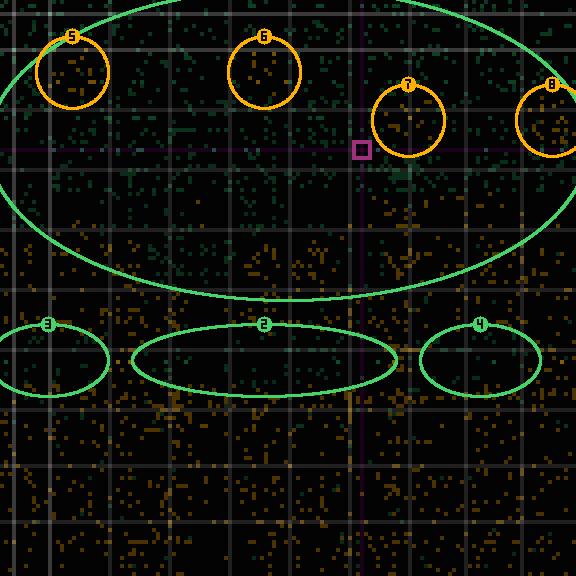
Don't like it? Change it — by intent or by action. Reply and say where you actually stand, or engage — run the demo, bind a room, send one objection — and the pixel moves with you. Either way, you own it from here.
What to look at, in this order — the short tour, picked for you
- The trigger, recomputed in front of you — thetadriven.com/commit
Open it twice. The same work produces the same boundary reading both times — which is the property an adjuster needs and the one an argument about model quality can never have.
thetadriven.com/commit · 🔨 builder
- The claim, written to be attacked
One falsifiable sentence, the command to check it, and an explicit list of what is NOT claimed. The not-claimed list is the part worth reading first — it is what makes the rest bindable.
thetadriven.com/blog/2026-07-04-decidable-on-silicon-the-claim-we-checked · 🎤 voice
- Placement, not a score — thetadriven.com/pixel
Why a measured position survives a dispute and a quality grade does not. This is the distinction your claims adjuster will care about long before your underwriter does.
thetadriven.com/pixel · 📐 architect
Nothing here needs to be read in full. One link is a complete visit.
Your rooms — what lights up from your coordinate, green spaces first
1 🎩 The Operator · 2 🔒 The Vault · 3 📐 The Architect · 4 🎭 The Performer · 5 🧭 The Navigator · 6 ☕ The Network · 7 🎤 The Voice · 8 🔨 The Builder · 9 🧪 The Laboratory
The to-do list — if you wanted to do something
- 1.Five minutes online, not a dinner — I scrapped the Hartford one, the logistics were blocking the conversation rather than helping it.
- 2.Open thetadriven.com/commit twice before we speak. If the two readings ever differ, the whole thing is worthless and you have saved yourself the call.
- 3.Tell me what a carrier would need in the trigger language before anyone would bind it. That is the thing I genuinely do not know and you do.
- 4.If the parametric framing is wrong for this risk, say so plainly. I would rather hear it from you than find out from an underwriter.