
thetadriven.com/rooms/operator/amjad-replit
Amjad at Replit
The Operator · rank 3 in this room
▦ your coordinate: B1,A2 (Tactics.Speed ⊕ Strategy.Goal)
Your inner monologue — written for you; correct it and it improves
The bet is a billion developers — people who never called themselves developers shipping real software, and agents doing the parts that used to gate them out. I think that is directionally obvious and most of the objections to it are status anxiety wearing a technical costume. The objection that is not, and the one I would want answered before it becomes the story, is accountability. When someone who cannot read the diff ships something that matters, the question is not whether they should have been allowed to — it is what record exists afterward. Every prior wave of access got that infrastructure late and paid for the gap in public. If a billion people are going to build, the record of what got built has to be as cheap and automatic as the building.
Easy to agree with, easy to reject — either reaction is signal. If it misses you, say where it broke.
The whole idea, in four pieces — no jargon, nothing to memorize
You are building for a billion developers and I want to talk about the record rather than the risk. Every prior wave of access got its accountability infrastructure late, and the platform at the front of the wave is the one that pays for the gap in public. Four pieces, about a minute.
1 · The objection that is not status anxiety
Most of the pushback on democratised building is people protecting a moat. The one that is not is accountability: what record exists after someone who cannot read the diff ships something that matters.
Separating the real objection from the defensive ones is worth doing before the story gets written by someone else.
2 · Automatic, or it does not exist at a billion users
Nobody writes this record. The work emits it, free, without anyone opting in or knowing the term for it.
Any answer that requires the builder to do something extra is an answer that works for a thousand people and fails for a billion.
3 · It gives the non-expert builder something a third party can check
Someone who cannot read the diff still ends up holding an artifact that their client, their auditor or their insurer can verify without them.
That is the access argument, not the safety argument — it belongs to your thesis rather than against it.
4 · It grades nothing
Not the code, not the builder, not the output. Where the work landed against what it declared, with the limit written down.
A system that scores a million amateur builders would be a bad product and a worse idea. Placement is not a score and that distinction is the whole design.
If you can say where you are, how far in you are, and which way is bigger — you already hold the same model an architect holds. The rest is vocabulary.
Why you're ranked here
You sit near the center of The Operator's cloud — the nine-room decomposition of what this work needs the world to understand. Rank 3 means: of everyone this room knows about, this belongs to you most. That is an honorific, not an algorithmic judgment of worth — and it's correctable by replying. Nothing here asks you to pass it to anyone.
You have a coordinate — B1,A2 (Tactics.Speed ⊕ Strategy.Goal)
Your coordinate is an occupation intersection: one room is where you'd actually be working, the other is the quality control on that work. That cell, B1,A2 (Tactics.Speed ⊕ Strategy.Goal), sits on the same 12×12 lattice every commit in this repo attests against — the same map that prices an AI agent's drift. Someone else may share your coordinate; what's yours alone is what lights up when you stand there — your confidence pixel — and that lighting is exactly what ranks the rooms below: your green spaces first, your red spaces where growth points. You didn't have to do anything to get placed. This is reverse market segmentation, not a judgment — and the direction you could grow in is readable straight off the map.
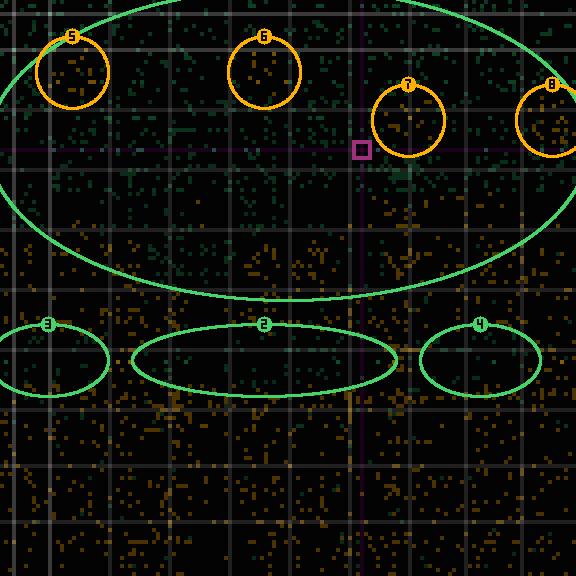
Don't like it? Change it — by intent or by action. Reply and say where you actually stand, or engage — run the demo, bind a room, send one objection — and the pixel moves with you. Either way, you own it from here.
What to look at, in this order — the short tour, picked for you
- One receipt, made by the work itself — thetadriven.com/commit
Open it twice. Byte-identical both times or the claim is false — that is the whole test, and you can run it without me.
thetadriven.com/commit · 🔨 builder
- The claim, written to be attacked
One sharp sentence, the command to check it, and an explicit list of what is deliberately NOT claimed. Read the not-claimed list first.
thetadriven.com/blog/2026-07-04-decidable-on-silicon-the-claim-we-checked · 🎤 voice
- The map — thetadriven.com/map
The whole argument at its top altitude, if you would rather see the shape than read the case for it.
thetadriven.com/map · 🧭 navigator
Nothing here needs to be read in full. One link is a complete visit.
Your rooms — what lights up from your coordinate, green spaces first
1 🎩 The Operator · 2 🔒 The Vault · 3 📐 The Architect · 4 🎭 The Performer · 5 🧭 The Navigator · 6 ☕ The Network · 7 🎤 The Voice · 8 🔨 The Builder · 9 🧪 The Laboratory
The to-do list — if you wanted to do something
- 1.Tell me whether the record problem is on the roadmap or deliberately deferred. Deliberately deferred is a perfectly good answer and I would rather hear it than be agreed with.
- 2.Open thetadriven.com/commit twice and confirm the two readings match. Ten seconds, nothing to install.
- 3.If accountability infrastructure is something you think arrives naturally with scale, tell me why — that would be the strongest counter to what I am building and I have not heard it made well.