
thetadriven.com/rooms/operator/harrison-chase-961287118-983504
Harrison at LangChain
The Operator · rank 13 in this room
▦ your coordinate: C1,C2 (Operations.Grid ⊕ Operations.Loop)
Your inner monologue — written for you; correct it and it improves
We have built most of the loop: build, test with evals, deploy, monitor every interaction from one dashboard. Trajectories are visible now in a way they were not two years ago. The thing I have not solved, and I am not sure the observability framing can solve, is that a trajectory is a narrative and a narrative is arguable. I can show you every step an agent took. I cannot yet hand you a single small object that says where the whole run landed relative to where it said it was going, computed the same way by anyone who reruns it. Everyone building on us will need that the first time a customer's legal team asks what the agent did, because at that moment a dashboard is evidence of instrumentation, not evidence of what happened.
Easy to agree with, easy to reject — either reaction is signal. If it misses you, say where it broke.
The whole idea, in four pieces — no jargon, nothing to memorize
You have built more of the agent loop than anyone, including the evaluation and trajectory parts. I think one small object is still missing from it and I want to know if I am early or simply wrong. Four pieces, about a minute.
1 · A trajectory is a narrative, and narratives are arguable
You can show every step an agent took. That is genuinely more than existed two years ago, and it is still a story someone can dispute the reading of.
The first time a customer's legal team asks what the agent did, a dashboard is evidence of instrumentation rather than evidence of what happened.
2 · One object for the whole run
A single small reading: where the run landed relative to where it said it was going. Not a summary of the trace — a deterministic function of it.
Small matters. It has to be glanceable by a human and recomputable by a machine, or it will not be used.
3 · Computed the same way by anyone who reruns it
No model in the path, so the same run produces the same object in your hands, your customer's hands, and their counsel's hands.
Harbor and sandboxed evals get you reproducible execution. This is the reproducible artifact that comes out the other end.
4 · It never says the run was good
Quality stays with your evals, where it belongs and where it is undecidable in the formal sense. This only ever says where.
If it read as competitive with LangSmith rather than as a primitive LangSmith could emit, that is my writing failing, not the idea.
If you can say where you are, how far in you are, and which way is bigger — you already hold the same model an architect holds. The rest is vocabulary.
Why you're ranked here
You sit near the center of The Operator's cloud — the nine-room decomposition of what this work needs the world to understand. Rank 13 means: of everyone this room knows about, this belongs to you most. That is an honorific, not an algorithmic judgment of worth — and it's correctable by replying. Nothing here asks you to pass it to anyone.
You have a coordinate — C1,C2 (Operations.Grid ⊕ Operations.Loop)
Your coordinate is an occupation intersection: one room is where you'd actually be working, the other is the quality control on that work. That cell, C1,C2 (Operations.Grid ⊕ Operations.Loop), sits on the same 12×12 lattice every commit in this repo attests against — the same map that prices an AI agent's drift. Someone else may share your coordinate; what's yours alone is what lights up when you stand there — your confidence pixel — and that lighting is exactly what ranks the rooms below: your green spaces first, your red spaces where growth points. You didn't have to do anything to get placed. This is reverse market segmentation, not a judgment — and the direction you could grow in is readable straight off the map.
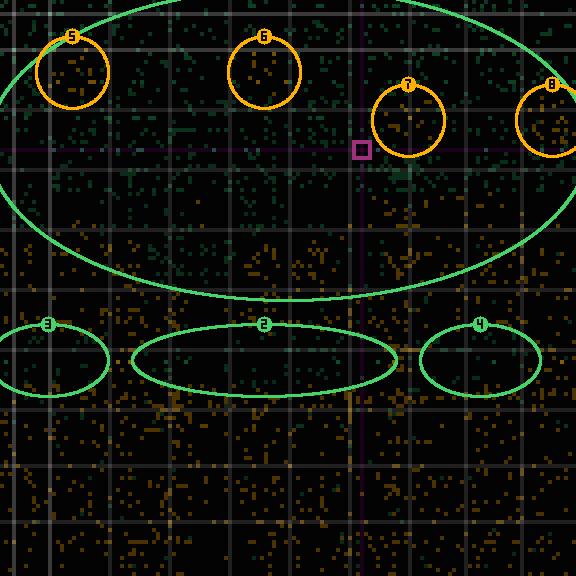
Don't like it? Change it — by intent or by action. Reply and say where you actually stand, or engage — run the demo, bind a room, send one objection — and the pixel moves with you. Either way, you own it from here.
What to look at, in this order — the short tour, picked for you
- One receipt, made by the work itself — thetadriven.com/commit
Open it twice. Byte-identical both times or the claim is false — that is the whole test, and you can run it without me.
thetadriven.com/commit · 🔨 builder
- The claim, written to be attacked
One sharp sentence, the command to check it, and an explicit list of what is deliberately NOT claimed. Read the not-claimed list first.
thetadriven.com/blog/2026-07-04-decidable-on-silicon-the-claim-we-checked · 🎤 voice
- Position instead of a score — thetadriven.com/pixel
Why placing a piece of work on a map is a different act from grading it, and why only one of the two survives a dispute.
thetadriven.com/pixel · 📐 architect
Nothing here needs to be read in full. One link is a complete visit.
Your rooms — what lights up from your coordinate, green spaces first
1 🎩 The Operator · 2 🔒 The Vault · 3 📐 The Architect · 4 🎭 The Performer · 5 🧭 The Navigator · 6 ☕ The Network · 7 🎤 The Voice · 8 🔨 The Builder · 9 🧪 The Laboratory
The to-do list — if you wanted to do something
- 1.Tell me whether a customer's legal or risk team has actually asked you for this yet. Early and wrong look identical from here and you can tell them apart.
- 2.Open thetadriven.com/commit twice and confirm the two readings match. Ten seconds, no signup.
- 3.If this is a primitive LangSmith should just emit, say that plainly — I would rather it existed than that I owned it.