
thetadriven.com/rooms/operator/joao-crewai
João at CrewAI
The Operator · rank 17 in this room
▦ your coordinate: C3,A1 (Operations.Flow ⊕ Strategy.Law)
Your inner monologue — written for you; correct it and it improves
Our own research says it plainly: security and governance is the number one thing enterprise leaders weigh when they evaluate an agent platform, ahead of integration and ahead of performance. We publish that because it is true and because we would rather name the objection than be surprised by it. Then you sit in the actual procurement meeting and the question sharpens into something no platform currently answers — not is it governed, but can you show me, later, where a specific run landed, in a form my own team regenerates without you. At hundreds of millions of automations a month, that question does not scale as a human process. It has to be an artifact the run produces about itself, or the citizen developers we are betting on never get out of the pilot.
Easy to agree with, easy to reject — either reaction is signal. If it misses you, say where it broke.
The whole idea, in four pieces — no jargon, nothing to memorize
Your own 2026 report puts security and governance at thirty-four percent — the top enterprise priority, ahead of integration and ahead of reliability. I think the sharp version of that question has no answer yet from any platform. Four pieces, about a minute.
1 · The procurement question is narrower than 'is it governed'
In the room it becomes: show me, later, where a specific run landed, in a form my own team regenerates without you.
That is a different requirement from a governance feature list, and it is the one that stalls a pilot at the point where it would otherwise expand.
2 · At your volume it cannot be a human process
Hundreds of millions of automations a month means no review queue, no attestation workflow, and no person in the loop can be the answer.
It has to be something each run emits about itself, automatically, or it does not exist at your scale.
3 · Citizen developers cannot personally vouch for a run
Legal, HR and procurement teams building their own agents is the bet, and those builders are exactly the population who cannot answer a technical challenge about what their agent did.
An artifact the run produces is what lets someone build without also having to defend the internals they never touched.
4 · It does not claim the automation was correct
Only where it landed relative to what it declared. The limit is stated in writing beside the claim.
Modesty about scope is what survives a procurement review. Overclaiming is what gets a platform removed from the shortlist.
If you can say where you are, how far in you are, and which way is bigger — you already hold the same model an architect holds. The rest is vocabulary.
Why you're ranked here
You sit near the center of The Operator's cloud — the nine-room decomposition of what this work needs the world to understand. Rank 17 means: of everyone this room knows about, this belongs to you most. That is an honorific, not an algorithmic judgment of worth — and it's correctable by replying. Nothing here asks you to pass it to anyone.
You have a coordinate — C3,A1 (Operations.Flow ⊕ Strategy.Law)
Your coordinate is an occupation intersection: one room is where you'd actually be working, the other is the quality control on that work. That cell, C3,A1 (Operations.Flow ⊕ Strategy.Law), sits on the same 12×12 lattice every commit in this repo attests against — the same map that prices an AI agent's drift. Someone else may share your coordinate; what's yours alone is what lights up when you stand there — your confidence pixel — and that lighting is exactly what ranks the rooms below: your green spaces first, your red spaces where growth points. You didn't have to do anything to get placed. This is reverse market segmentation, not a judgment — and the direction you could grow in is readable straight off the map.
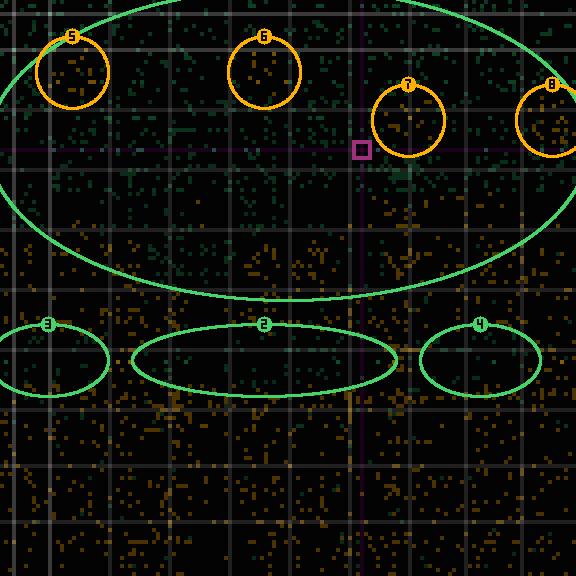
Don't like it? Change it — by intent or by action. Reply and say where you actually stand, or engage — run the demo, bind a room, send one objection — and the pixel moves with you. Either way, you own it from here.
What to look at, in this order — the short tour, picked for you
- One receipt, made by the work itself — thetadriven.com/commit
Open it twice. Byte-identical both times or the claim is false — that is the whole test, and you can run it without me.
thetadriven.com/commit · 🔨 builder
- The claim, written to be attacked
One sharp sentence, the command to check it, and an explicit list of what is deliberately NOT claimed. Read the not-claimed list first.
thetadriven.com/blog/2026-07-04-decidable-on-silicon-the-claim-we-checked · 🎤 voice
- The map — thetadriven.com/map
The whole argument at its top altitude, if you would rather see the shape than read the case for it.
thetadriven.com/map · 🧭 navigator
Nothing here needs to be read in full. One link is a complete visit.
Your rooms — what lights up from your coordinate, green spaces first
1 🎩 The Operator · 2 🔒 The Vault · 3 📐 The Architect · 4 🎭 The Performer · 5 🧭 The Navigator · 6 ☕ The Network · 7 🎤 The Voice · 8 🔨 The Builder · 9 🧪 The Laboratory
The to-do list — if you wanted to do something
- 1.Tell me whether procurement wants reproducibility or a governance checkbox. Your answer genuinely changes what I build, and you have sat in more of those rooms this year than I will in five.
- 2.Open thetadriven.com/commit twice and confirm the readings match. Ten seconds and no signup.
- 3.If your thirty-four percent is mostly about access control rather than evidence, tell me — I would be reading your own data wrong and would want to know.