
thetadriven.com/rooms/performer/scott-cognition
Scott at Cognition
The Performer · rank 21 in this room
▦ your coordinate: B1,C3 (Tactics.Speed ⊕ Operations.Flow)
Your inner monologue — written for you; correct it and it improves
Eighty-nine percent of the code our engineers commit is committed by Devin. I say that as a fact about throughput, and the second-order version of it is the part I think about: the review surface grew faster than any human review process can. My position is that agents free people from toil rather than replace them, and I mean it — but the honest version requires that a person can still tell, cheaply, where a given piece of agent work landed relative to what was asked. Reading the diff does not scale at that ratio. What scales is a small artifact the work emits about itself that a human glances at and a machine recomputes. Without it, freeing people from toil quietly turns into asking them to rubber-stamp volume.
Easy to agree with, easy to reject — either reaction is signal. If it misses you, say where it broke.
The whole idea, in four pieces — no jargon, nothing to memorize
Eighty-nine percent of the code your engineers commit is Devin's, and you have said publicly that agents should not replace engineers. Both of those are yours, and together they make a review problem I think is worth solving. Four pieces, about a minute.
1 · The review surface grew faster than review did
At that ratio, reading the diff is not a process — it is a formality that a person performs on volume they cannot actually absorb.
Which quietly turns 'freeing people from toil' into asking them to rubber-stamp, and that is the failure mode your own public position is against.
2 · A glanceable object per unit of work
One small reading of where a piece of agent work landed relative to what was asked. A human takes it in at a glance; a machine recomputes it exactly.
Glanceable is the requirement. Anything a reviewer has to study is just another diff.
3 · Deterministic, so it can be trusted at volume
No model in the path. Same work, same reading, every time, which is what makes it safe to rely on without spot-checking the checker.
A probabilistic reviewer of a probabilistic writer does not compose into oversight; it composes into two things to verify.
4 · It says nothing about code quality
Not correctness, not style, not whether the approach was sound. Where it landed against what was asked, and the limit is on the record.
This is a throughput instrument, not a safety argument — and the narrow version is the one that actually holds.
If you can say where you are, how far in you are, and which way is bigger — you already hold the same model an architect holds. The rest is vocabulary.
Why you're ranked here
You sit near the center of The Performer's cloud — the nine-room decomposition of what this work needs the world to understand. Rank 21 means: of everyone this room knows about, this belongs to you most. That is an honorific, not an algorithmic judgment of worth — and it's correctable by replying. Nothing here asks you to pass it to anyone.
You have a coordinate — B1,C3 (Tactics.Speed ⊕ Operations.Flow)
Your coordinate is an occupation intersection: one room is where you'd actually be working, the other is the quality control on that work. That cell, B1,C3 (Tactics.Speed ⊕ Operations.Flow), sits on the same 12×12 lattice every commit in this repo attests against — the same map that prices an AI agent's drift. Someone else may share your coordinate; what's yours alone is what lights up when you stand there — your confidence pixel — and that lighting is exactly what ranks the rooms below: your green spaces first, your red spaces where growth points. You didn't have to do anything to get placed. This is reverse market segmentation, not a judgment — and the direction you could grow in is readable straight off the map.
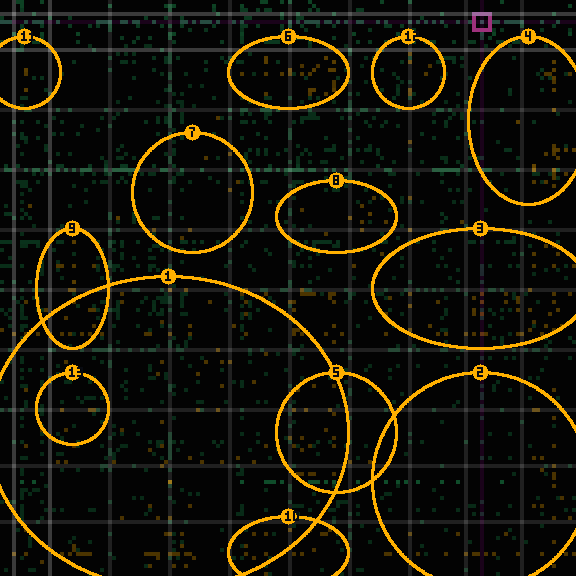
Don't like it? Change it — by intent or by action. Reply and say where you actually stand, or engage — run the demo, bind a room, send one objection — and the pixel moves with you. Either way, you own it from here.
What to look at, in this order — the short tour, picked for you
- One receipt, made by the work itself — thetadriven.com/commit
Open it twice. Byte-identical both times or the claim is false — that is the whole test, and you can run it without me.
thetadriven.com/commit · 🔨 builder
- Position instead of a score — thetadriven.com/pixel
Why placing a piece of work on a map is a different act from grading it, and why only one of the two survives a dispute.
thetadriven.com/pixel · 📐 architect
- The claim, written to be attacked
One sharp sentence, the command to check it, and an explicit list of what is deliberately NOT claimed. Read the not-claimed list first.
thetadriven.com/blog/2026-07-04-decidable-on-silicon-the-claim-we-checked · 🎤 voice
Nothing here needs to be read in full. One link is a complete visit.
Your rooms — what lights up from your coordinate, green spaces first
1 🎭 The Performer · 2 🔒 The Vault · 3 📐 The Architect · 4 🧭 The Navigator · 5 ☕ The Network · 6 🎤 The Voice · 7 🔨 The Builder · 8 🧪 The Laboratory · 9 🎩 The Operator
The to-do list — if you wanted to do something
- 1.Tell me how you keep a person meaningfully in the loop at that ratio right now. Whatever the honest answer is, it is more interesting to me than anything I could pitch.
- 2.Open thetadriven.com/commit twice and check the readings are identical. That is the entire claim.
- 3.If a per-unit reading is something Cognition would build in a week rather than adopt, say so — it is a fair answer and I would rather have it early.